This essay takes its starting point from Professor Li Wei’s paper The Problem of Standpoints and the Central Message of Qiwulun — Zhuangzi’s Overlooked Doctrine of “Yinshi”, exploring the problem of standpoints, examining the attitudes and judgments involved in communication, and — with the help of the Ladder of Inference model — searching for methods of effective communication that can lead to genuine shared understanding.
The Problem of Standpoints in Qiwulun
The character “qi” (齊, to equalize) is not part of Zhuangzi’s own text, but rather an interpretive title added by later readers. The actual subject of Qiwulun is the problem of standpoints — specifically, the concept of yinshi (因是, “following the that-ness”). The passage that most clearly expresses this theme:
Things have no other; things have a “this.” From the other side you cannot see it; from knowledge (one’s own established mind / standpoint) you know it. So it is said: the “other” emerges from the “this,” and the “this” follows from the “other.” This is the theory of simultaneous arising. Though they arise together, they also die together; where the possible arises, the impossible also arises; where the impossible arises, the possible also arises; following the “that,” the “this” is negated; following the “this,” the “that” is negated. Therefore the sage does not proceed by fixed principles, but illuminates all by reference to Heaven — this too is “following the that-ness.” The “this” is also “that”; the “that” is also “this.” The “that” has its own is-and-is-not; the “this” also has its own is-and-is-not. Is there even a “that” and a “this”? Or is there no “that” and “this”? When “that” and “this” can no longer be paired off as opposites, this is called the pivot of the Way. The pivot, once grasped, stands at the center of the ring and can respond to the infinite. The “is” is one infinite; the “is-not” is another infinite. Therefore: nothing is better than illumination.
Let’s unpack this line by line.
Things have no other; things have a “this.” From the other side you cannot see it; from knowledge you know it. So it is said: the “other” emerges from the “this,” and the “this” follows from the “other.” This is the theory of simultaneous arising.
To understand “is-and-is-not” here, we need to read the Nanhua commentary: “If you follow your completed mind (chengxin) as teacher, who then would be without a teacher? Must you know of change and choose in your own mind? Even a fool has one. Not yet having a completed mind and yet to have is-and-is-not — this is like setting out for Yue today and arriving yesterday.”
When Zhuangzi talks about “is-and-is-not,” his focus isn’t on the content of any particular judgment, but on the source of such judgments — the chengxin (completed mind / fixed predisposition). As Hansen glossed it, chengxin corresponds to hermeneutic prejudice — the standpoint one already occupies before engaging in observation or speech.
Though they arise together, they also die together; where the possible arises, the impossible also arises; where the impossible arises, the possible also arises; following the “that,” the “this” is negated; following the “this,” the “that” is negated. Therefore the sage does not proceed by fixed principles, but illuminates all by reference to Heaven — this too is “following the that-ness.”
Questions of object depend on our standpoint. Even the sage, who has no particular personal standpoint, still “illuminates by reference to Heaven” — there is still a standpoint. All people are constrained by standpoints; none can escape this.
When “that” and “this” can no longer be paired off as opposites, this is called the pivot of the Way… Therefore: nothing is better than illumination.
Since “is” and “is-not” are both infinite, “nothing is better than illumination” (mo ruo yi ming) emphasizes: while holding your own standpoint, you must also perceive and include the standpoints of others. That is — be open. Insisting on seeing things from only one angle is unwise.
Zhuangzi’s purpose in proposing yinshi is to reflect on the universal fact that people have standpoints — to reveal the root of disagreement and ways of responding to it. At its core, the teaching uses the Dao-perspective (“viewing things through the Dao”) to dissolve the fragmentation caused by object-perspective (“viewing things through objects”), and to show that the ideal yinshi means following the Dao itself.
Attitudes and Judgments: What Should We Even Discuss?
Evaluation describes the relationship between a subject and an object — the state of the object as seen from the subject’s viewpoint — and is a form of value judgment. In everyday communication, the evaluative language we use falls into two categories: attitudes and judgments. An attitude is a purely subjective emotional expression; a judgment is a more objectively grounded value evaluation.
In communication, we need to be careful not to conflate the two. Judgments can be discussed; attitudes cannot — and should not — be. Discussion aims at shared understanding, at finding common ground. Mixing in attitudes derails this, leading to people talking past each other or generating conflict.
So which disputes can actually be resolved through discussion?
We can divide conversation topics into those with existing consensus (no argument there) and those without. It’s the zone of disagreement that matters. Within that zone, we can further divide into objectively verifiable claims and subjectively unverifiable ones. The latter are essentially expressions of attitude — we should set them aside and focus on the objectively verifiable content.
People often talk like this in everyday life:
- “This movie is garbage — I watched half an hour and had no idea what the director was going for.”
- “That book is terrible, don’t bother — I gave up halfway through, it was meaningless.”
- “That escape room’s theme was nothing special — don’t go, I went once and the experience was awful.”
All of these are expressions of the speaker’s own experience or feelings, but they’re dressed up as verdicts about the thing itself. Express your attitude directly: “I didn’t enjoy that film,” “I disliked that book” — not “this film is bad” or “that book is no good.”
Beyond that, our universal judgments about things are always constrained by our standpoint, as the Qiushui chapter says: “Magnify what is great, and everything becomes great; diminish what is small, and everything becomes small; affirm what is affirmed, and everything is affirmed; negate what is negated, and everything is negated; then what is right, treat as right, and everything becomes right; what is wrong, treat as wrong, and everything becomes wrong.” Following the X in something leads to judging all things as X.
We are always constrained by standpoints — but does that mean we can’t make judgments at all? Not quite. It means we should seek higher standpoints when judging: standards that are as broadly applicable as possible. A film can be evaluated from the angle of cinematography, character development, narrative tension. But saying “it’s good because it’s enjoyable” — that’s not a judgment anyone else can work with.
What we should discuss is the main substantive claims on each side of a judgment — not attitudes — and that’s what makes for effective communication that can lead to shared understanding.
The Ladder of Inference: The Limits of Cognition
Let’s bring the standpoint problem together with cognitive limitations.
L’s course introduced the Ladder of Inference:
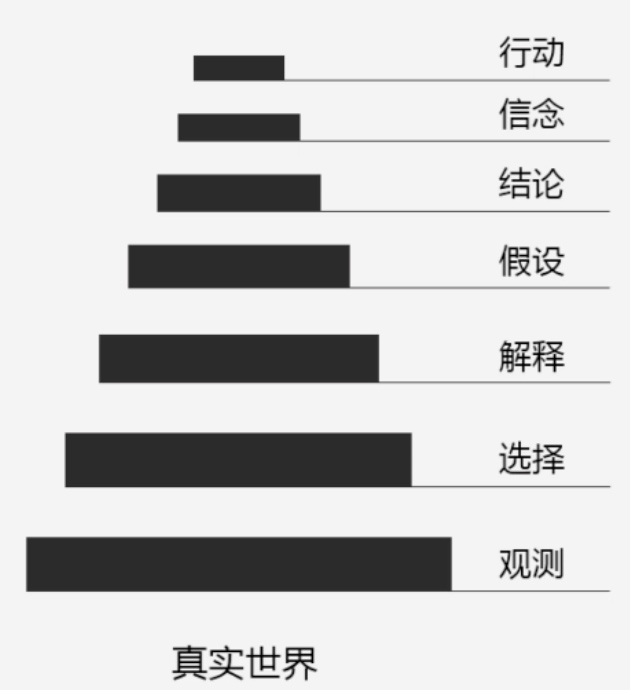
The full truth of the “real world” is unknowable. Phenomenology reminds us: our reason’s only object is phenomena. Of what we can observe, our minds selectively receive what they encounter. We then try to explain those received phenomena, form assumptions (the backbone of Toulmin-style argumentation), draw conclusions, and finally — guided by our beliefs (standpoints) — make decisions and take action.
This model maps nicely onto Qiwulun.
“From the other side you cannot see it; from knowledge (chengxin / standpoint) you know it” — we can only grasp things from our standpoint.
But “therefore distinctions mean there is something undistinguished; debates mean there is something indisputable… the sage holds it all inwardly; the multitude debate to display it. Therefore: debates mean there is something unseen.” Clinging to one’s standpoint creates distinctions — closes off that standpoint — leading to self-limitation and an inability to hear others or see contrary evidence.
The way out is to locate your standpoint and transcend it. Only then can you view problems from a higher dimension, from multiple angles, with greater objectivity.
As I wrote in an earlier piece Thatness of Sky: Light: what we can grasp is always the characteristics of a thing, not the concrete thing itself. Logic: an object falls under a concept — we separate objects into properties and individuals. Fa: Confucius is a philosopher. Here a is the individual constant (Confucius); F is the predicate (being a philosopher). Concrete individuals are beyond our grasp; in all forms of artistic expression, what we take hold of is only certain characteristics of individuals. Our concepts form through the fusion of infinite horizons. The higher our vantage point, the broader our historical and cultural field of vision, the more accurately we can evaluate the significance of everything within reach — by magnitude, distance, nearness.
Based on the Ladder of Inference, there are two common failure modes in communication:
- Lobbing conclusions from the top of the ladder. This makes dialogue impossible — both sides repeat and emphasize their own views, unable to resolve the disagreement.
- Overconfidence in one’s own conclusions. This causes people to skip the lower rungs of the ladder, imprisoning themselves in their own standpoint — unable to hear others, unable to see unfavorable evidence.
So how do we break through our standpoints and communicate effectively?
Effective Communication: Set Down the Standpoint, Seek Common Ground
First, be clear about the purpose of discussion. It is never to determine who wins. It is always to get closer to the truth. All discussion must center on consensus; all discussion aims at reaching consensus. We may never fully know the truth — so the critical task is to find the shared ground between us, expanding our field of vision and acquiring new angles, enabling us to grasp the essence of problems from a higher vantage.
Consensus: not merely “we both know this,” but “we both know that the other knows.” The former is common knowledge; the latter is genuine consensus. See The Iceberg of Cognition for the full distinction.
Drawing on The Iceberg of Cognition, here are the key practices for breaking through standpoints and reaching effective communication:
One: Clarify the shared terms of the discussion.
Before engaging, define what is actually being discussed. Avoid letting the scope drift or letting the two sides talk about different things entirely. Paraphrasing the other person’s position back to them is a useful way to verify mutual understanding.
Two: Establish the boundaries of what can actually be discussed.
We said earlier: the zone of productive discussion is the objectively verifiable zone of disagreement. Don’t evaluate or engage with pure attitude expressions. Figure out exactly where the shared ground ends and the genuine divergence begins, then seek consensus or compromise within that space.
Three: Frame your position as description, not attitude evaluation.
You can’t change another person’s emotional stance in a single conversation. Recognize the richness of their experience and the limits of your own perspective. Try to understand where the other person is coming from — they may have a different Ladder of Inference and arrive at a different conclusion for entirely legitimate reasons. Lobbing attitude evaluations accomplishes nothing in an effective exchange.
Four: Question your own reasoning — start from your own position.
Acknowledge that you might be wrong. Interrogate each rung of your own Ladder of Inference — from observation to action — spelling out your reasoning at each step and clarifying your thinking. Ask yourself at every step: are there other possibilities?
Five: Question the other’s reasoning — start from their position.
Walk the other person’s reasoning backward from conclusion to premise. Understand their logic and look for gaps. Examine their evidence and its reliability. Use their perspective to check where your own reasoning might be incomplete.
Finally — always bring an open, humble heart to the conversation.
Further reading:
