
The question of how to live is a battlefield of everyone against everyone. This post simply shares where I currently stand on it. I’ll approach it through two questions:
- What is the meaning of life?
- How can we experience life more fully?
What Is the Meaning of Life?
Existence and the Collapse of Meaning
First, my answer to the first question: life has no meaning.
We are thrown by chance into a disordered world. We appear to have absolute freedom and infinite possibility — but the journey of life is extremely brief, and the possibilities are extremely limited. We arrive by chance and leave by chance. Nothing in this process requires us to do anything in particular. In other words, our entire lives have no predetermined purpose.
Even so, we must carry this meaningless life — carry this soul with nowhere to rest — and bravely sail on. This voyage has no destination, but out on the open sea we keep setting new waypoints. These waypoints are the “rules of sailing” we set for ourselves; we use these rules to reach each marker, to seek what we call “a sense of meaning.”
Existence precedes essence. We exist first, then explore meaning, then give meaning to existence. The voyage has no destination; we ourselves set waypoint after waypoint and give the voyage meaning. Through this act of anchoring, we seek meaning in this endless ocean journey and give meaning to our existence. After all, what defines us is not “the voyage itself” but “the meaning we give to the voyage.”
This retrospectively assigned “sense of meaning,” however, carries two hidden dangers.
First, it determines that value is internal and relative. Everything we do is ultimately just following the course we’ve laid for ourselves. This anchoring is always a kind of self-generated illusion — it exists by virtue of our own, immediate, tangible feedback. In our own eyes, this course exists and has value. You might find value consensus with some people, but values differ from person to person; your actions cannot win everyone’s approval. Fortunately, our actions don’t need to seek others’ approval — as long as we ourselves feel it has meaning, that’s enough.
Second, this anchoring is prone to losing feedback and producing a sense of collapse. A workaholic who anchors their sense of meaning in work, for example — if their hard work doesn’t bring the expected performance review or their boss’s recognition, they fall into self-doubt or inferiority complex, lose enthusiasm for life, and feel a kind of collapse.
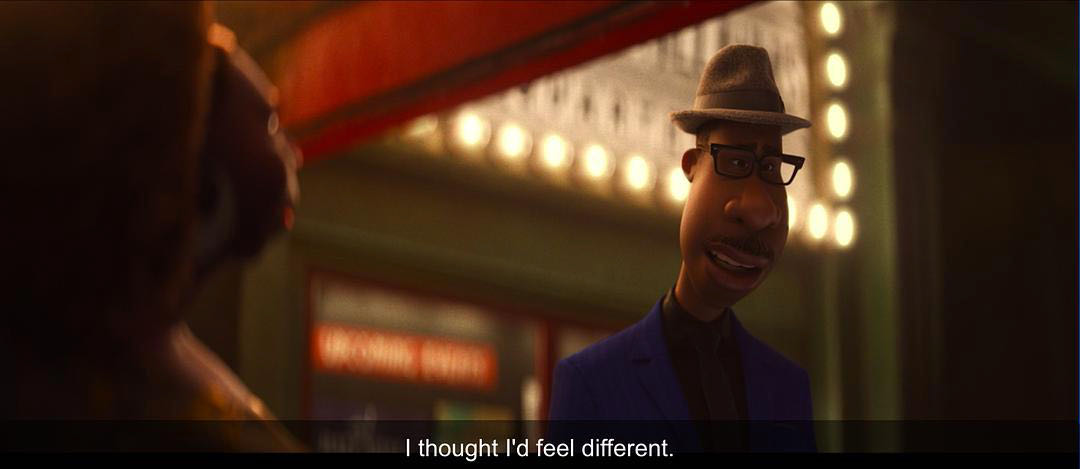
Or the reverse: in Soul, Joe Gardner spends his whole life pursuing his jazz dream, and after many trials he finally gets to perform alongside a famous musician — to great success. That night after the show, he suddenly feels strangely empty. His lifelong effort has gotten him what he wanted, and he discovers that beyond a brief rush of excitement, nothing is actually different. His next-day goal is gone. “So… what now?” he murmurs.
Or, in the fast-paced city life, we’re always rushing; there are always urgent things to do. Each one looks like a P0 priority on its own. We exhaust ourselves trying to do everything as well as possible, and the more we try to do everything perfectly, the less we can achieve completeness — life becomes a hollow collection of fragments. The sudden sense of absurdity makes us feel that the shape of our life has already broken.
The Present Moment and the Experience of Life
Before addressing these problems we need to establish an existentialist proposition: a person exists as a series of individual moments. It is precisely because a person exists that a person is a person. In other words, as Adler said: “Life is a series of moments. The most important thing is this very moment.”
The only “real” thing I have ever been deeply convinced of is this: right now, I am alive — I exist, I breathe, I perceive the world around me — and that is the only reality. Some say the highest value is to contribute a brick to the edifice of human progress. Others say the greatest meaning is to give light and warmth to the cause of world peace. Never mind that these lofty ideals are too distant for ordinary people to see — even if they exist, what of it? The universe has existed for billions of years; human history spans only a few thousand. Earth is a drop in the ocean; human history is a mayfly. Those so-called ideals — from the scale of the cosmos, everything is meaningless.

Yet even so, we still exist — isn’t that already an extraordinary miracle? The only certainty is the present. The only thing that matters is now, this very moment. A person must first exist before anything about life can be discussed. Understanding this, we need to pay attention to each step underfoot and find in each one solid, powerful support and joy — to experience the scenery, the setbacks, and the bitterness of the journey.
What life aesthetics calls “experience” is the key to connecting a person’s inner consciousness with external reality, and the individual with society. Life is composed of a continuous stream of experiential fragments from reality — an uneven mixture of suffering, choice, regret, solitude, hope, and happiness.
We wander through the great river of time: discovering life, experiencing the world, embracing what is beautiful, using our minds in an experimental and expansive way, stirring our emotions, appreciating, learning, adding depth to our lives, experiencing the world as richly as possible.
Then, gradually, we come to understand: the meaning of life is not given by so-called “major life events” — it falls into the unremarkable, impermanent details of daily living. Like the nurse who brought me a blanket while I waited in the hospital for a COVID test result in the middle of the night. The stray cat that was waiting at my door begging for food when I got home. The neighbor who brought milk tea to thank me for taking in a package. The moment I opened a music app and heard Wandering in the River of Time, looking forward to the season finale of Loki that Wednesday.
These are my present. My life. My meaning.
How Can We Experience Life More Fully?
I’ve talked about the absurdity of meaning-free existence and the remedy: experiencing the life of the present moment. Now to the second question — how can we experience life more fully? Here are some approaches I’ve practiced and found genuinely useful:
- The courage to embrace ordinariness
- Lengthening the view, seeing life from above
- Openness and variety; accumulating sweet moments
- Seeking connection; staying kind
- Knowledge, sensitivity, and imagination
- Living seriously and positively
The Courage to Embrace Ordinariness
The Courage to Be Disliked points to “the courage to embrace ordinariness” — which asks us to accept the ordinary self. Being ordinary means being unremarkable; we are simply one among countless people, arriving here by chance. But ordinary does not mean incapable. We have no need to specially flaunt our superiority.
Today’s society sells anxiety; articles and courses that manufacture anxiety are everywhere, because everyone wants to be the most excellent version of themselves. But when anxiety becomes pervasive, people’s hearts grow restless, forgetting that every person is an ordinary but unique individual — you can strive and improve, pursue and challenge yourself — but don’t forget the courage to embrace ordinariness.
As that line goes: “Achievement is not defined externally. It all depends on whether you are living according to your own will.” (Yuxi, Pixar designer)
Lengthening the View, Seeing Life from Above
“Bird’s-eye view” is the unique thinking style of the protagonist in Summer Time Rendering — in moments of confusion, another self appears in the mind to view the scene from above for objective analysis. This thinking mode is in fact “self-distancing” with a lengthened field of view, helping you avoid becoming so absorbed in yourself that you can’t let go.
The workaholic and Joe Gardner from Soul both suffered a sense of collapse because they suddenly lost immediate feedback from their anchor point. The root cause is that their “sense of meaning” came from too narrow a single source, and their pursuit of it was too single-minded. If you lengthen your view — even if things aren’t going well in your job, you can try a different job; or step back further and realize that work is not the whole of life, that there are many other meaningful things still to do. No rule requires you to be the best at anything.
Lengthening the view and seeing life from above is a good remedy for the sense of collapse.
Openness and Variety; Accumulating Sweet Moments
The sense of collapse of meaning arises when your anchor is too narrow and you chase that single sense of meaning too intently. If you diversify your life — seek out more things you’re interested in — even if you lose feedback from one anchor, another will continue to replenish your sense of meaning.
The character designer for Soul, Yuxi, said in an interview: “A lifetime is one long experience. If you can experience as many things as possible in the same amount of time, that’s absolutely worthwhile.”
If we compare the fragments of our life to the memory balls in Inside Out, we find that those balls never store a single, pure emotion — they’re colorful, rich emotional mixtures. In such a varied wealth of life experience, we encounter a multidimensional sense of meaning.
Beyond that, accumulating the sweet moments you discover unexpectedly is also a key part of experiencing life — and the secret to accumulating them is openness.
We mentioned that value is relative; so we should not anchor meaning to value alone (especially practical value). Instead, we should recognize the complex richness of the real world. Only doing things you consider “valuable” is very one-sided, and a shame — it means missing the many round, sharp, niche, and humble beauties of life. Lowering the threshold of value actually makes it easier to find “sweet moments” in daily life.
So by lowering our value priorities, we can accumulate sweet moments more effectively — because we become more open, and therefore happier, and also better at experiencing life objectively and continuing to improve.
In the world, some people set themselves up as authorities and some blindly follow; some people celebrate niche aesthetics and others see it as showing off. These are just different people, at different times, in different places, in different moods, observing the world in their own ways. Ultimately, as long as you can see the essence of things and accumulate sweet moments from many different vantage points, does it matter which method you use?
Seeking Connection; Staying Kind
The life experience we want is not vague, ethereal happiness; the meaning we give to our lives should not be empty and hollow. It needs something real to anchor it. If you were told right now that you’re in a “brain-in-a-vat” experiment — that all your friends, family, and the surrounding world are your own illusions — every achievement and joy you’ve ever felt would be swallowed by loneliness.
So when we give meaning to existence, we must seek connection with real things — that is, connection and interaction with the external world, with others, even with our future selves.
In positive psychology, giving and sharing are very important sources of happiness. Whether giving someone a gift, offering affirmation and thanks, helping someone with a small task, or sharing your life and joy with others — all of these build a bridge of goodwill between you and the external world. Being a kind person, doing things that are meaningful to yourself, to others, and to the world, and in that process building connection with yourself, with others, and with the world — feeling happiness, satisfaction, and joy — this is always a reliable strategy.
So if you want to experience a happy life, it often comes less from what you have than from what you can give — from how many bridges of goodwill you can build.
Knowledge, Sensitivity, and Imagination
The experience of life is grounded in our perception of the world. In my view, the three most important elements for improving perceptual capacity come from The Moon and Sixpence: knowledge, sensitivity, and imagination.
Knowledge Knowledge determines the scope of our perception of the world (content).
Learning and growing is a lifelong endeavor. Drawing in knowledge sharpens our cognitive capacity so we can understand and engage with things we previously couldn’t fully grasp — or couldn’t grasp at all. If limited knowledge causes us to miss some life experiences, that is ultimately a loss.
The broader and deeper our knowledge, the more deeply and simply we can understand the world.
Sensitivity Sensitivity determines the edges of our perception of the world (outline).
As I said above, the only real certainty is “I am alive” — and to make that aliveness full and meaningful, we have to give it meaning ourselves. How? The key is to experience and feel life.
Our lived experience is made up of scattered fragments. What we call “feeling” is the response to experience — the projection of ourselves onto the world. “Sensitivity” is the range of that projection.
The world’s experiences are vast and complex. “Projective capacity” is like a circle whose center is your own perspective — the radius of projection is how far you can feel, and the area it covers is the world you can perceive.
Cultivating knowledge keeps our perception honest and lets us see the essence of things clearly; cultivating sensitivity makes our perception richer — expanding the perceptual edge, experiencing more, deeper, or previously “unimaginable” things. Raising your vantage point — regardless of direct experience — expands the horizon of the world you can perceive.
The value of our existence lies in the fact that we fixed this center; the meaning of being alive lies in expanding that boundary.
Imagination Imagination determines the radiated reach of our perception of the world (extension).
Uta Hagen wrote in Respect for Acting: “Talent is a combination of high sensitivity, an easily wounded heart, a high-performance intuitive apparatus (strong visual, auditory, tactile, gustatory, and olfactory senses), a lively imagination, a grasp of reality, a strong wish to communicate personal experience and feelings, and an impulse to have one’s whole being seen and heard.” Robert McKee in Story also emphasizes that a playwright must have “perceptiveness” and “extraordinary imagination.”
I came across an interesting graphic novel recently — Montage of Life — where the author drew her imagined world from her own perspective and shared it with us in the experiential world.

In the eyes of those who cannot hear the music, those who dance look like madmen. The dancers know the rhythm of the world; they understand that what is enough to resist the absurdity and emptiness of life is making life itself into an interesting adventure.
Imagination can give us a world we cannot access through experience. It determines the radiated reach of our perception and expands the world’s extension.
Living Seriously and Positively
Last and most importantly, we need a positive attitude toward life — to live seriously.
I recently bought a graphic novel called The Crocodile That Died 100 Days Later. On the first page, the author establishes that the crocodile protagonist will die in 100 days. The reader knows; the crocodile doesn’t. The author drew one panel per day for the remaining days, depicting the crocodile’s daily life — extraordinarily ordinary.
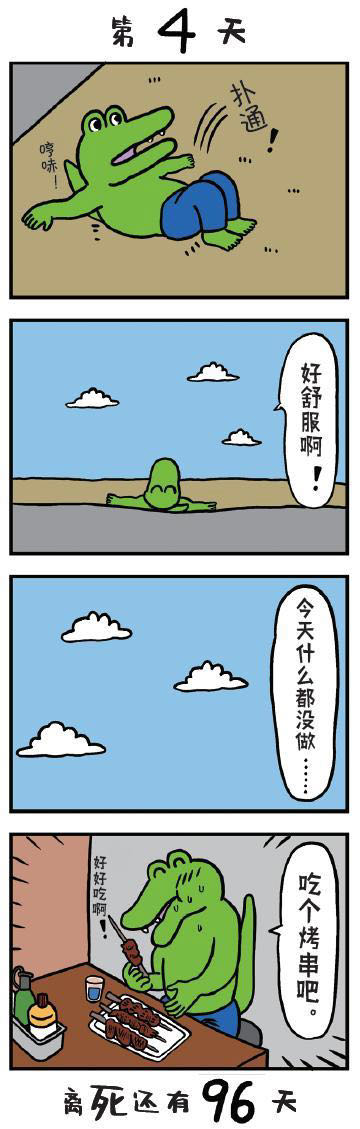
Perhaps every person is like the crocodile — bound to be gone some day 100 days from now, arriving by chance and leaving by chance. It seems absurd and beyond control. But if you’re conscious that life has an end, you work harder to make life go in a good direction. When we know everyone has a final day, we should live every day seriously.
I particularly love quiet, calm living, because it lets me engage more attentively. Before my graduate entrance exam I was anxious and restless — preparing for a cross-discipline exam while also doing a teaching practicum. But one day after teaching elementary school students, I sat in the schoolyard under a tree and read Zhuangzi to the sound of students reading aloud in the classroom. A sense of happiness washed over me. The quiet atmosphere of learning and the mysterious sense of the natural order made me forget the chaos and noise of daily life. I felt a sense of life that was complete and beautiful. To this day I still miss that exam-preparation period.
I once saw a sentence on the window of a Sisyphus bookstore: “Life is a pure flame, and we live by an invisible sun within us.” But I prefer its other half: “Life is a succession of happy moments; we do not live merely to exist.” Each person is caught in solitude — yet wild and carefree, swept by the great wind. I think: once you see through the world’s pretense, the world is yours.
As long as you have lived seriously, everything is enough. I wish you — reading this — a hopeful and earnest life.
