- React source version: v16.11.0
- Annotated source notes: airingursb/react
Before writing this post, I read through a number of articles on Hooks source code analysis. Most were either too superficial or not thorough enough. So this post goes deep into the source code, line by line, from the ground up. We’ll start with how useState is used, then cover the rules, explain the principles, build a simple implementation, and finally walk through the actual React source.
I’m also using the opening of this post to include a Hooks overview — I kept meaning to add it in the first two posts but ran out of space.
Note: It’s been two months since my last post — I’ve been busy with work. React has gone from 16.9 to 16.11 in that time. After reviewing the changelogs, none of the updates touched Hooks, so I’ve just updated my source annotations to 16.11.
1. React Hooks Overview
Hooks are a new feature introduced in React 16.8. They let you use state and other React features without writing a class component. At their core, Hooks are a special category of functions — they all start with use by convention — that inject functionality into Function Components, giving them capabilities that were previously only available in Class Components.
For example, we used to say Function Components couldn’t hold state, hence “Stateless Function Components.” With useState, a Function Component can now maintain state just like a Class Component. @types/react even renamed SFC to FC to reflect this.
1.1 Motivation
The Hooks introduction in the React docs cites three motivations:
- It’s hard to reuse stateful logic between components
- Complex components become hard to understand
- Classes are confusing
First, reusing stateful logic between components — this was the main topic of the previous post, so I won’t repeat it here.
Second, complex components becoming hard to understand. This mainly applies to Class Components. We end up writing code scattered across lifecycle methods — fetching data in both componentDidMount and componentDidUpdate, event bindings alongside unrelated logic, and so on. Components bloat up, and logic gets buried in lifecycle functions. React development becomes “lifecycle-oriented programming.” Hooks shift this to “business-logic-oriented programming” — developers can stop thinking about lifecycles they shouldn’t have to care about.
Third, classes are confusing. Functional programming is simply easier to understand than OOP. Going a step further into performance: do Hooks slow things down by creating functions on every render? No. In modern browsers, the raw performance difference between closures and classes only shows up in extreme scenarios. In fact, Hooks can be more efficient in some ways:
- Hooks avoid the overhead of class instances and constructor-based event handler binding.
- Idiomatic code with Hooks doesn’t need deep component tree nesting — unlike with HOCs, render props, and context. A smaller tree means less work for React.
The benefits of React Hooks go beyond being more functional, fine-grained, and readable. There are three more advantages:
- Flat structure instead of nesting: Like
async/awaitsolving callback hell, Hooks solve HOC nesting hell. Render props can also address this viacompose, but it’s more cumbersome and introduces extra entities. - Hooks can reference other Hooks: Custom Hooks are extremely flexible.
- Easier separation of UI and state: Component logic and rendering become more decoupled.
1.2 Hooks API
- useState
- useEffect
- useContext
- useReducer
- useCallback
- useMemo
- useRef
- useImperativeHandle
- useLayoutEffect
- useDebugValue
- useResponder
All of these will be covered in future posts. This one focuses on useState.
1.3 Custom Hooks
Custom Hooks let you extract component logic into reusable functions. I highly recommend https://usehooks.com/ — it’s a collection of practical custom Hooks you can drop straight into your projects. It’s a great showcase of how reusable and elegant Hooks can be.
2. useState Usage and Rules
import React, { useState } from 'react'

const App: React.FC = () => {
    const [count, setCount] = useState<number>(0)
    const [name, setName] = useState<string>('airing')
    const [age, setAge] = useState<number>(18)

    return (
        <>
            <p>You clicked {count} times</p>
            <button onClick={() => {
                setCount(count + 1)
                setAge(age + 1)
            }}>
                Click me
            </button>
        </>
    )
}

export default App
If you’ve used Redux before, this will look familiar. You have an initial state, dispatch actions, a reducer processes them, new state is returned, and the component re-renders.
This is equivalent to the following Class Component:
import React from 'react'

class App extends React.Component {
  constructor(props) {
    super(props);
    this.state = {
      count: 0,
      age: 18,
      name: 'airing'
    };
  }

  render() {
    return (
      <>
        <p>You clicked {this.state.count} times</p>
        <button onClick={() => this.setState({
            count: this.state.count + 1,
            age: this.state.age + 1
        })}>
          Click me
        </button>
      </>
    );
  }
}

export default App
The Function Component version is much cleaner. useState is simple to use, but there’s one important rule: Hooks must be called in the same order on every render. Always call Hooks at the top level of your component — never inside loops, conditions, or nested functions.
Why this rule? Let’s build a simple implementation of useState to understand it.
3. How useState Works: A Simple Implementation
3.1 Demo 1: dispatch
The useState usage pattern resembles Redux. Let’s implement one from scratch, Redux-style:
function useState(initialValue) {
    let state = initialValue
    function dispatch(newState) {
        state = newState
        render(<App />, document.getElementById('root'))
    }
    return [state, dispatch]
}
Replacing the React import with our own:
import React from 'react'
import { render } from 'react-dom'

function useState(initialValue: any) {
    let state = initialValue
    function dispatch(newState: any) {
        state = newState
        render(<App />, document.getElementById('root'))
    }
    return [state, dispatch]
}

const App: React.FC = () => {
    const [count, setCount] = useState(0)
    const [name, setName] = useState('airing')
    const [age, setAge] = useState(18)

    return (
        <>
            <p>You clicked {count} times</p>
            <p>Your age is {age}</p>
            <p>Your name is {name}</p>
            <button onClick={() => {
                setCount(count + 1)
                setAge(age + 1)
            }}>
                Click me
            </button>
        </>
    )
}

export default App
Clicking the button does nothing — count and age don’t change. Our useState doesn’t persist state between renders; each re-render resets it to the initial value. We need to store it somewhere external.
3.2 Demo 2: Remembering State
Let’s improve it:
let _state: any
function useState(initialValue: any) {
    _state = _state | initialValue
    function setState(newState: any) {
        _state = newState
        render(<App />, document.getElementById('root'))
    }
    return [_state, setState]
}
The button now responds, but only partially. If you remove the age and name useState calls, it works fine. The problem is we’re only using one variable — it can only store state for one Hook. We need a memo of sorts: an array to hold all state values, with carefully maintained indices.
3.3 Demo 3: Memoization
Let’s improve it again:
let memoizedState: any[] = [] // stores all Hook values
let cursor = 0 // current index into memoizedState

function useState(initialValue: any) {
    memoizedState[cursor] = memoizedState[cursor] || initialValue
    const currentCursor = cursor
    function setState(newState: any) {
        memoizedState[currentCursor] = newState
        cursor = 0
        render(<App />, document.getElementById('root'))
    }
    return [memoizedState[cursor++], setState] // return current state and advance cursor
}
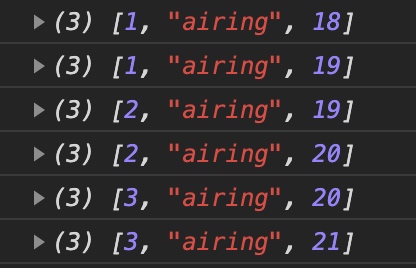
After three button clicks, memoizedState looks like this:
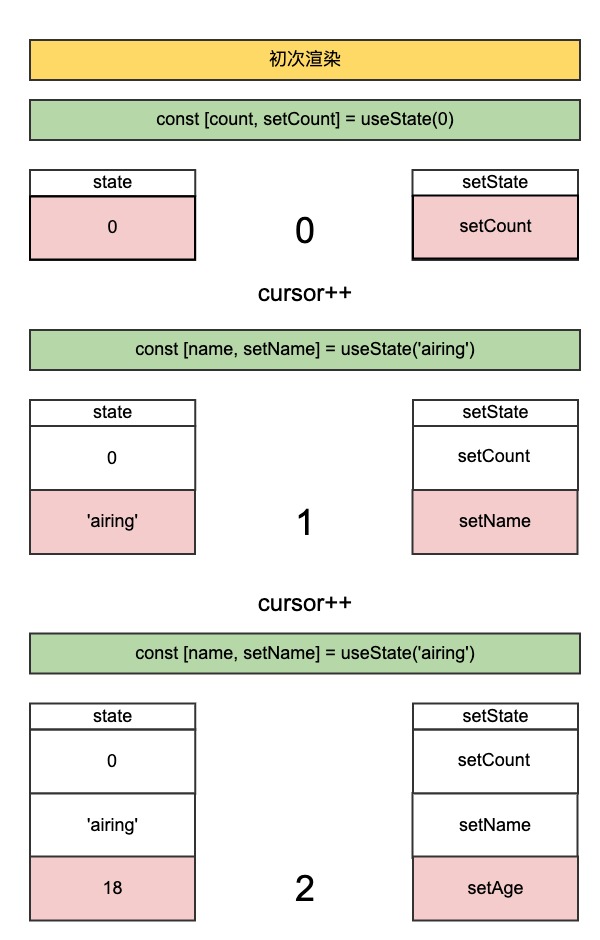
On first render, each useState call stores its initial state at the corresponding index and binds setState to that index.
On button click, setCount and setAge fire. Each setState has a reference to its own cursor index, so calling it updates only the right slot.
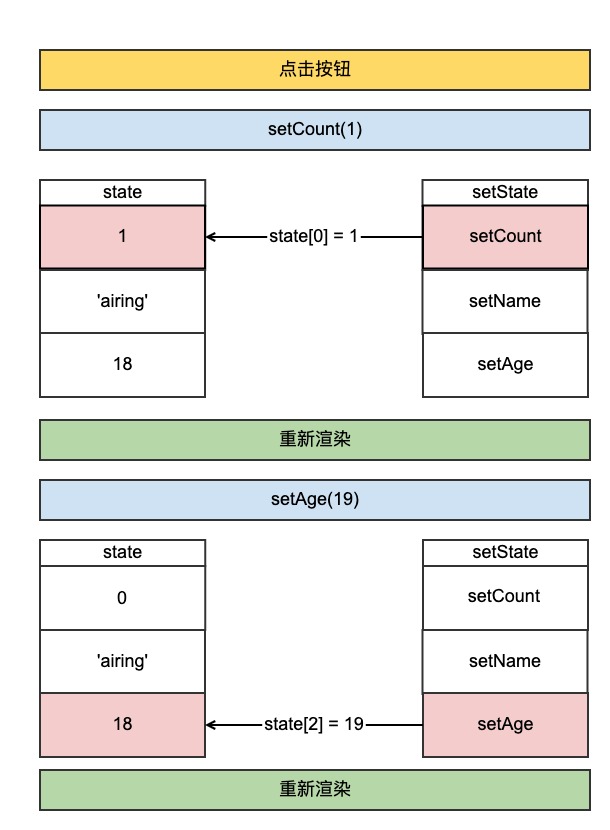
This is a simplified implementation, so each setState call triggers a full re-render.
On re-render, each useState runs again in sequence — but memoizedState already contains the previous state values, so the initial value isn’t used.
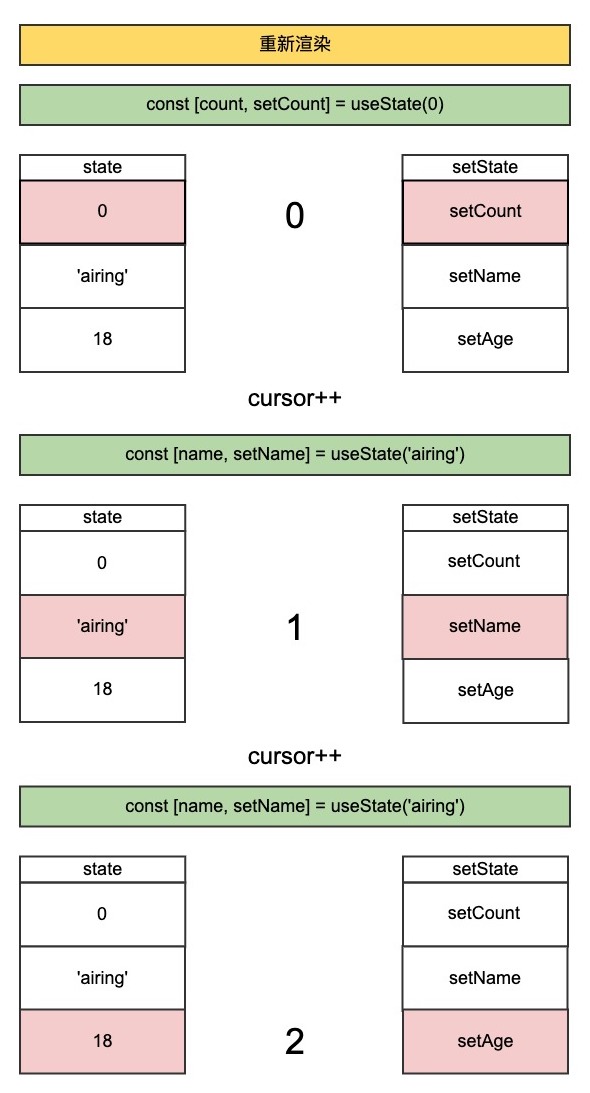
Now the answer to the rule we left unanswered becomes clear: why must Hooks be called in the same order on every render? Because memoizedState is indexed by call order. If the order of Hook calls changes, the array has no way of knowing — it’ll match the wrong state to the wrong Hook. That’s why Hooks must always be called at the top level, not inside loops, conditions, or nested functions.
4. useState Source Code
4.1 Entry Point
In the entry file packages/react/src/React.js, useState comes from packages/react/src/ReactHooks.js:
export function useState<S>(initialState: (() => S) | S) {
  const dispatcher = resolveDispatcher();
  return dispatcher.useState(initialState);
}
resolveDispatcher() returns ReactCurrentDispatcher.current, so useState is really ReactCurrentDispatcher.current.useState.
What is ReactCurrentDispatcher?
import type {Dispatcher} from 'react-reconciler/src/ReactFiberHooks';

const ReactCurrentDispatcher = {
  current: (null: null | Dispatcher),
}
The actual useState implementation lives in packages/react-reconciler/src/ReactFiberHooks.js, which contains all the core logic for React Hooks.
4.2 Type Definitions
4.2.1 Hook
First, let’s look at the Hook type:
export type Hook = {
  memoizedState: any, // points to the current Fiber's last fully committed state value

  baseState: any, // initial state / state after each dispatch
  baseUpdate: Update<any, any> | null, // the update that needs processing; after update, stores previous update for rollback
  queue: UpdateQueue<any, any> | null, // cached update queue for multiple update actions

  next: Hook | null, // link to the next Hook — Hooks form a singly linked list
};
The structure is very similar to our simplified implementation. memoizedState is effectively an array — more precisely, React Hooks form a singly linked list, where Hook.next points to the next Hook.
4.2.2 Update & UpdateQueue
What are baseUpdate and queue? Here are their types:
type Update<S, A> = {
  expirationTime: ExpirationTime, // when this update expires
  suspenseConfig: null | SuspenseConfig,
  action: A,
  eagerReducer: ((S, A) => S) | null,
  eagerState: S | null,
  next: Update<S, A> | null, // link to next Update

  priority?: ReactPriorityLevel,
};

type UpdateQueue<S, A> = {
  last: Update<S, A> | null,
  dispatch: (A => mixed) | null,
    lastRenderedReducer: ((S, A) => S) | null,
      lastRenderedState: S | null,
};
An Update represents a single state update during a React render cycle. UpdateQueue is a queue of updates, along with the dispatch function. The details of Fiber scheduling and React’s update flow will be covered in a separate post.
4.2.3 HooksDispatcherOnMount & HooksDispatcherOnUpdate
Two dispatcher objects determine which implementation runs:
const HooksDispatcherOnMount: Dispatcher = {
  readContext,

  useCallback: mountCallback,
  useContext: readContext,
  useEffect: mountEffect,
  useImperativeHandle: mountImperativeHandle,
  useLayoutEffect: mountLayoutEffect,
  useMemo: mountMemo,
  useReducer: mountReducer,
  useRef: mountRef,
  useState: mountState,
  useDebugValue: mountDebugValue,
  useResponder: createResponderListener,
};

const HooksDispatcherOnUpdate: Dispatcher = {
  readContext,

  useCallback: updateCallback,
  useContext: readContext,
  useEffect: updateEffect,
  useImperativeHandle: updateImperativeHandle,
  useLayoutEffect: updateLayoutEffect,
  useMemo: updateMemo,
  useReducer: updateReducer,
  useRef: updateRef,
  useState: updateState,
  useDebugValue: updateDebugValue,
  useResponder: createResponderListener,
};
4.3 First Render
4.3.1 renderWithHooks
React Fiber starts processing Function Components in beginWork() in ReactFiberBeginWork.js. For Function Components, it calls updateFunctionComponent, which in turn calls:
case FunctionComponent: {
      const Component = workInProgress.type;
      const unresolvedProps = workInProgress.pendingProps;
      const resolvedProps =
        workInProgress.elementType === Component
          ? unresolvedProps
          : resolveDefaultProps(Component, unresolvedProps);
      return updateFunctionComponent(
        current,
        workInProgress,
        Component,
        resolvedProps,
        renderExpirationTime,
      );
    }
Inside updateFunctionComponent, Hooks are handled through:
nextChildren = renderWithHooks(
  current,
  workInProgress,
  Component,
  nextProps,
  context,
  renderExpirationTime,
);
So the core entry point for React Hooks rendering is renderWithHooks. Here’s the implementation (with error handling and __DEV__ code stripped):
export function renderWithHooks(
  current: Fiber | null,
  workInProgress: Fiber,
  Component: any,
  props: any,
  refOrContext: any,
  nextRenderExpirationTime: ExpirationTime,
): any {
  renderExpirationTime = nextRenderExpirationTime;
  currentlyRenderingFiber = workInProgress;
  nextCurrentHook = current !== null ? current.memoizedState : null;

  ReactCurrentDispatcher.current =
    nextCurrentHook === null
      ? HooksDispatcherOnMount
      : HooksDispatcherOnUpdate;


  let children = Component(props, refOrContext);

  if (didScheduleRenderPhaseUpdate) {
    do {
      didScheduleRenderPhaseUpdate = false;
      numberOfReRenders += 1;

      nextCurrentHook = current !== null ? current.memoizedState : null;
      nextWorkInProgressHook = firstWorkInProgressHook;

      currentHook = null;
      workInProgressHook = null;
      componentUpdateQueue = null;

      ReactCurrentDispatcher.current = __DEV__
        ? HooksDispatcherOnUpdateInDEV
        : HooksDispatcherOnUpdate;

      children = Component(props, refOrContext);
    } while (didScheduleRenderPhaseUpdate);

    renderPhaseUpdates = null;
    numberOfReRenders = 0;
  }

  ReactCurrentDispatcher.current = ContextOnlyDispatcher;

  const renderedWork: Fiber = (currentlyRenderingFiber: any);

  renderedWork.memoizedState = firstWorkInProgressHook;
  renderedWork.expirationTime = remainingExpirationTime;
  renderedWork.updateQueue = (componentUpdateQueue: any);
  renderedWork.effectTag |= sideEffectTag;

  // ... cleanup

  return children;
}
The key part at the start:
nextCurrentHook = current !== null ? current.memoizedState : null;

ReactCurrentDispatcher.current =
    nextCurrentHook === null
      ? HooksDispatcherOnMount
      : HooksDispatcherOnUpdate;
If the current Fiber is null, it’s the first render, and ReactCurrentDispatcher.current.useState becomes mountState. Otherwise it becomes updateState.
4.3.2 mountState
Here’s mountState:
// Called when useState is used for the first time
function mountState<S>(
  initialState: (() => S) | S,
): [S, Dispatch<BasicStateAction<S>>] {
  // Create a new Hook and return the current workInProgressHook
  const hook = mountWorkInProgressHook();
  if (typeof initialState === 'function') {
    initialState = initialState();
  }
  hook.memoizedState = hook.baseState = initialState;

  // Create a new queue
  const queue = (hook.queue = {
    last: null, // last update: {action, next}
    dispatch: null,
    lastRenderedReducer: basicStateReducer,
    lastRenderedState: (initialState: any), // state at last render
  });

  const dispatch: Dispatch<
    BasicStateAction<S>,
    > = (queue.dispatch = (dispatchAction.bind(
      null,
      // bind current fiber and queue
      ((currentlyRenderingFiber: any): Fiber),
      queue,
    ): any));
  return [hook.memoizedState, dispatch];
}
4.3.3 mountWorkInProgressHook
mountWorkInProgressHook creates a new Hook and returns the current workInProgressHook:
function mountWorkInProgressHook(): Hook {
  const hook: Hook = {
    memoizedState: null,

    baseState: null,
    queue: null,
    baseUpdate: null,

    next: null,
  };

  // On first render, workInProgressHook is null
  if (workInProgressHook === null) {
    firstWorkInProgressHook = workInProgressHook = hook;
  } else {
    // Append the new Hook to the end of the linked list
    workInProgressHook = workInProgressHook.next = hook;
  }
  return workInProgressHook;
}
4.3.4 dispatchAction
mountState does one more critical thing: it binds the current Fiber and queue to dispatchAction:
const dispatch: Dispatch<
    BasicStateAction<S>,
    > = (queue.dispatch = (dispatchAction.bind(
      null,
      // bind current fiber and queue
      ((currentlyRenderingFiber: any): Fiber),
      queue,
    ): any));
Here’s dispatchAction:
function dispatchAction<S, A>(
  fiber: Fiber,
  queue: UpdateQueue<S, A>,
  action: A,
) {
  const alternate = fiber.alternate;
  if (
    fiber === currentlyRenderingFiber ||
    (alternate !== null && alternate === currentlyRenderingFiber)
  ) {
    // Re-render: a new update occurred during the current render cycle
    didScheduleRenderPhaseUpdate = true;
    const update: Update<S, A> = {
      expirationTime: renderExpirationTime,
      suspenseConfig: null,
      action,
      eagerReducer: null,
      eagerState: null,
      next: null,
    };
    if (renderPhaseUpdates === null) {
      renderPhaseUpdates = new Map();
    }
    const firstRenderPhaseUpdate = renderPhaseUpdates.get(queue);
    if (firstRenderPhaseUpdate === undefined) {
      renderPhaseUpdates.set(queue, update);
    } else {
      let lastRenderPhaseUpdate = firstRenderPhaseUpdate;
      while (lastRenderPhaseUpdate.next !== null) {
        lastRenderPhaseUpdate = lastRenderPhaseUpdate.next;
      }
      lastRenderPhaseUpdate.next = update;
    }
  } else {
    const currentTime = requestCurrentTime();
    const suspenseConfig = requestCurrentSuspenseConfig();
    const expirationTime = computeExpirationForFiber(
      currentTime,
      fiber,
      suspenseConfig,
    );

    // Store the update for computing the latest state during re-render
    const update: Update<S, A> = {
      expirationTime,
      suspenseConfig,
      action,
      eagerReducer: null,
      eagerState: null,
      next: null,
    };

    // Append the update to the end of the list.
    const last = queue.last;
    if (last === null) {
      // This is the first update. Create a circular list.
      update.next = update;
    } else {
      const first = last.next;
      if (first !== null) {
        update.next = first;
      }
      last.next = update;
    }
    queue.last = update;

    // Schedule a render update
    scheduleWork(fiber, expirationTime);
  }
}
The first branch handles re-render scheduling via Fiber — we’ll skip the details here. Just know that when fiber === currentlyRenderingFiber, it’s a re-render. During a re-render, didScheduleRenderPhaseUpdate is set to true, and renderWithHooks will loop and increment numberOfReRenders. All updates during re-render are stored in renderPhaseUpdates keyed by the Hook’s queue.
The final scheduleWork call will be analyzed in a separate post.
4.4 Updates
4.4.1 updateState
On subsequent renders, useState calls updateState:
function basicStateReducer<S>(state: S, action: BasicStateAction<S>): S {
  return typeof action === 'function' ? action(state) : action;
}

function updateState<S>(
  initialState: (() => S) | S,
): [S, Dispatch<BasicStateAction<S>>] {
  return updateReducer(basicStateReducer, (initialState: any));
}
updateState just calls updateReducer. The basicStateReducer simply returns the action value (calling it first if it’s a function). This means useState is really just a special case of useReducer with a built-in identity reducer.
4.4.2 updateReducer
function updateReducer<S, I, A>(
  reducer: (S, A) => S,
  initialArg: I,
  init?: I => S,
): [S, Dispatch<A>] {
  const hook = updateWorkInProgressHook();
  const queue = hook.queue;

  queue.lastRenderedReducer = reducer;

  if (numberOfReRenders > 0) {
    // Re-render case
    const dispatch: Dispatch<A> = (queue.dispatch: any);
    if (renderPhaseUpdates !== null) {
      const firstRenderPhaseUpdate = renderPhaseUpdates.get(queue);
      if (firstRenderPhaseUpdate !== undefined) {
        renderPhaseUpdates.delete(queue);
        let newState = hook.memoizedState;
        let update = firstRenderPhaseUpdate;
        do {
          const action = update.action;
          newState = reducer(newState, action);
          update = update.next;
        } while (update !== null);

        if (!is(newState, hook.memoizedState)) {
          markWorkInProgressReceivedUpdate();
        }

        hook.memoizedState = newState;
        if (hook.baseUpdate === queue.last) {
          hook.baseState = newState;
        }

        queue.lastRenderedState = newState;

        return [newState, dispatch];
      }
    }
    return [hook.memoizedState, dispatch];
  }

  const last = queue.last;
  const baseUpdate = hook.baseUpdate;
  const baseState = hook.baseState;

  let first;
  if (baseUpdate !== null) {
    if (last !== null) {
      last.next = null;
    }
    first = baseUpdate.next;
  } else {
    first = last !== null ? last.next : null;
  }
  if (first !== null) {
    let newState = baseState;
    let newBaseState = null;
    let newBaseUpdate = null;
    let prevUpdate = baseUpdate;
    let update = first;
    let didSkip = false;
    do {
      const updateExpirationTime = update.expirationTime;
      if (updateExpirationTime < renderExpirationTime) {
        if (!didSkip) {
          didSkip = true;
          newBaseUpdate = prevUpdate;
          newBaseState = newState;
        }
        if (updateExpirationTime > remainingExpirationTime) {
          remainingExpirationTime = updateExpirationTime;
        }
      } else {
        markRenderEventTimeAndConfig(
          updateExpirationTime,
          update.suspenseConfig,
        );

        // Loop through the circular list and apply each update
        if (update.eagerReducer === reducer) {
          newState = ((update.eagerState: any): S);
        } else {
          const action = update.action;
          newState = reducer(newState, action);
        }
      }
      prevUpdate = update;
      update = update.next;
    } while (update !== null && update !== first);

    if (!didSkip) {
      newBaseUpdate = prevUpdate;
      newBaseState = newState;
    }

    if (!is(newState, hook.memoizedState)) {
      markWorkInProgressReceivedUpdate();
    }

    hook.memoizedState = newState;
    hook.baseUpdate = newBaseUpdate;
    hook.baseState = newBaseState;

    queue.lastRenderedState = newState;
  }

  const dispatch: Dispatch<A> = (queue.dispatch: any);
  return [hook.memoizedState, dispatch];
}
updateReducer handles two cases:
- Normal update: a single update in the current render cycle.
- Re-render: a new update occurred during the current render cycle.
If numberOfReRenders > 0, it’s a re-render. The code keeps processing updates from renderPhaseUpdates until the cycle is clean, then assigns the result to Hook.memoizedState and Hook.baseState.
Note: In practice, you’d rarely hit a re-render with plain
useState— unless you callsetStateat the top level of a component, which would cause an infinite loop. React catches this:Too many re-renders. React limits the number of renders to prevent an infinite loop.
In the normal case, the do-while loop processes each update in the circular linked list:
do {
  if (update.eagerReducer === reducer) {
    newState = ((update.eagerState: any): S);
  } else {
    const action = update.action;
    newState = reducer(newState, action);
  }
  prevUpdate = update;
  update = update.next;
} while (update !== null && update !== first);
Updates with lower priority than the current render are skipped, and the first skipped update becomes the new Hook.baseUpdate. Subsequent updates will be re-applied on top of baseUpdate in a later render. This detail will be covered separately.
4.4.3 updateWorkInProgressHook
Note that updates retrieve the Hook differently from mounts:
function updateWorkInProgressHook(): Hook {
  if (nextWorkInProgressHook !== null) {
    // Re-render: reuse the existing work-in-progress hook
    workInProgressHook = nextWorkInProgressHook;
    nextWorkInProgressHook = workInProgressHook.next;

    currentHook = nextCurrentHook;
    nextCurrentHook = currentHook !== null ? currentHook.next : null;
  } else {
    // Normal update: clone from current hook
    currentHook = nextCurrentHook;

    const newHook: Hook = {
      memoizedState: currentHook.memoizedState,

      baseState: currentHook.baseState,
      queue: currentHook.queue,
      baseUpdate: currentHook.baseUpdate,

      next: null,
    };

    if (workInProgressHook === null) {
      workInProgressHook = firstWorkInProgressHook = newHook;
    } else {
      workInProgressHook = workInProgressHook.next = newHook;
    }
    nextCurrentHook = currentHook.next;
  }
  return workInProgressHook;
}
Two cases: if nextWorkInProgressHook is non-null, it’s a re-render and we continue processing. Otherwise, we clone the current Hook and return the new workInProgressHook.
5. Closing Thoughts
Here’s a snapshot of what a Hook’s data structure looks like at runtime:
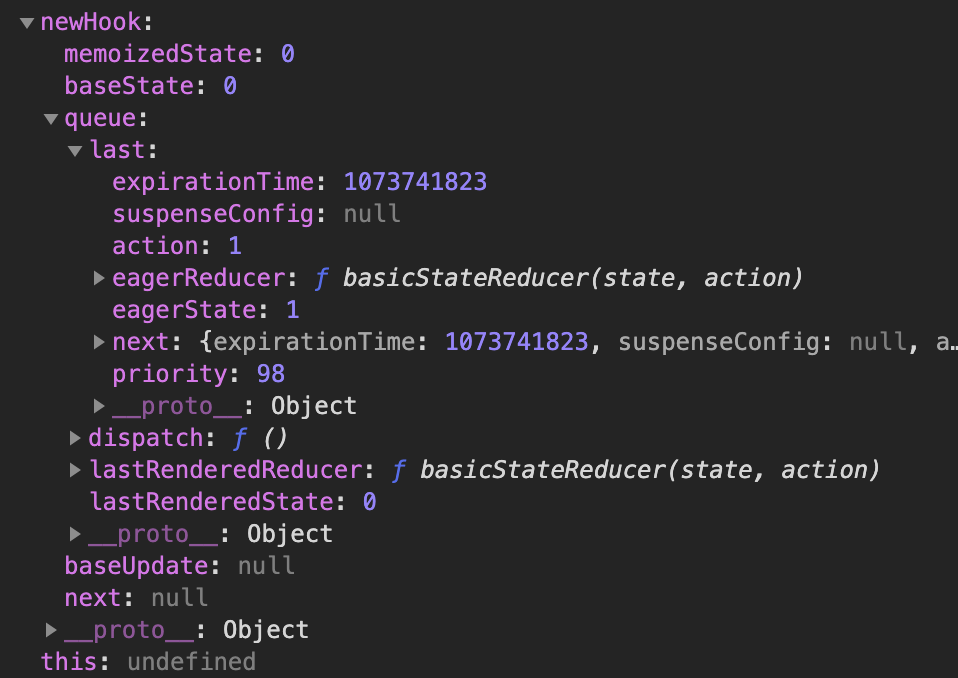
And a flow diagram summarizing everything we’ve analyzed:
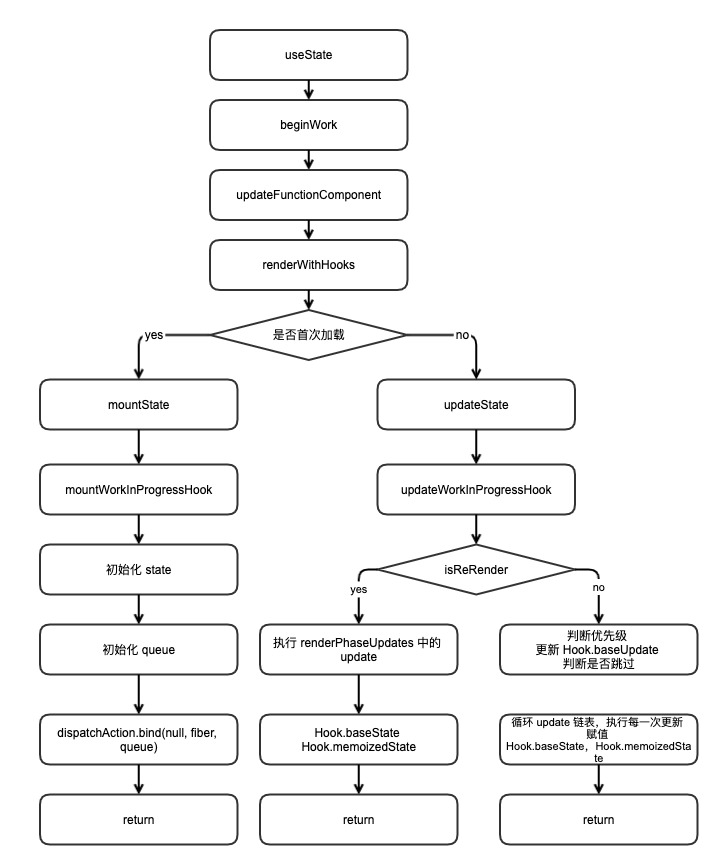
If anything about useState is still unclear, try writing a small demo and setting breakpoints at the key functions to step through it yourself.
