- React source version: v16.11.0
- Annotated source notes: airingursb/react
1. Introduction to useEffect
1.1 Why useEffect Exists
In the previous posts, we established that React Hooks let Functional Components gain the capabilities of Class Components. The main motivations were:
- It’s hard to reuse stateful logic between components
- Complex components become hard to understand
- Classes are confusing
Let’s dig into the second point. When writing Class Components, we’re forced to scatter our logic across lifecycle methods: fetching data in componentDidMount and componentDidUpdate, binding event listeners alongside unrelated setup code, and so on. Business logic ends up buried in lifecycle hooks. This shifts our thinking to “what do we need to do when the component mounts?” and “what do we need to do when it updates?” — in other words, lifecycle-oriented programming. The actual logic we write inside those lifecycle methods becomes a side effect of the component’s lifecycle.
The second consequence of lifecycle-oriented programming is that related logic gets split apart. For example, an event binding set up in componentDidMount needs to be cleaned up in componentDidUnmount — so the event management logic is split across two separate methods, making it harder to review and reason about:
import React from 'react'
class A extends React.Componment {
  componmentDidMount() {
    document.getElementById('js_button')
      .addEventListener('click', this.log)
  }
  componentDidUnmount() {
    document.getElementById('js_button')
      .removeEventListener('click', this.log)
  }

  log = () => {
    console.log('log')
  }

  render() {
    return (
      <div id="js_button">button</div>
    )
  }
}
useEffect brings the developer’s attention back to the business logic itself, away from lifecycle concerns. “Effect” is short for “side effect” — useEffect is the designated place for the side-effect logic that used to live in lifecycle methods.
1.2 useEffect Usage
Here’s the same code rewritten with useEffect:
import React, { useEffect } from 'react'
function A() {
  log() {
    console.log('log')
  }
  useEffect(() => {
    document
      .getElementById('js_button')
      .addEventListener('click', log)
    return () => {
      document
        .getElementById('js_button')
        .removeEventListener('click', log)
    }
  })
  return (<div id="js_button">button</div>)
}
useEffect takes two arguments. The first is a function that contains the effect (and optionally returns a cleanup function as a thunk). The second is an optional dependency array. If dependencies is omitted, the function runs after every render. If dependencies is provided, the function only runs when those values change. By extension, if dependencies is an empty array, the function only runs after the initial render.
useEffect(
  () => {
    const subscription = props.source.subscribe();
    return () => {
      subscription.unsubscribe();
    };
  },
  [props.source],
);
For more usage details: useEffect API Reference | React Docs
2. useEffect: A Simple Implementation
Based on the usage above, here’s a minimal useEffect implementation:
let _deps;

function useEffect(callback, dependencies) {
  const hasChanged = _deps
    && !dependencies.every((el, i) => el === _deps[i])
    || true;
  // If dependencies is absent, or if dependencies have changed, run the callback
  if (!dependencies || hasChanged) {
    callback();
    _deps = dependencies;
  }
}
3. useEffect Source Code
3.1 mountEffect & updateEffect
useEffect’s entry point lives in ReactFiberHooks.js, the same file as useState. Like useState, it runs mountEffect on the first render and updateEffect on subsequent renders. Let’s look at what each does.
For mountEffect:
function mountEffect(
  create: () => (() => void) | void,
  deps: Array<mixed> | void | null,
): void {
  return mountEffectImpl(
    UpdateEffect | PassiveEffect,
    UnmountPassive | MountPassive,
    create,
    deps,
  );
}
For updateEffect:
function updateEffect(
  create: () => (() => void) | void,
  deps: Array<mixed> | void | null,
): void {
  return updateEffectImpl(
    UpdateEffect | PassiveEffect,
    UnmountPassive | MountPassive,
    create,
    deps,
  );
}
Both take a function and an array — the callback and deps we pass to useEffect. And both delegate to mountEffectImpl / updateEffectImpl with identical first two arguments. Those first two arguments — UpdateEffect | PassiveEffect and UnmountPassive | MountPassive — come from ReactSideEffectTags and ReactHookEffectTags:
import {
  Update as UpdateEffect,
  Passive as PassiveEffect,
} from 'shared/ReactSideEffectTags';
import {
  NoEffect as NoHookEffect,
  UnmountPassive,
  MountPassive,
} from './ReactHookEffectTags';
Looking at the definitions:
// ReactSideEffectTags.js
export const NoEffect = /*              */ 0b0000000000000;
export const PerformedWork = /*         */ 0b0000000000001;
export const Placement = /*             */ 0b0000000000010;
export const Update = /*                */ 0b0000000000100;
export const PlacementAndUpdate = /*    */ 0b0000000000110;
export const Deletion = /*              */ 0b0000000001000;
export const ContentReset = /*          */ 0b0000000010000;
export const Callback = /*              */ 0b0000000100000;
export const DidCapture = /*            */ 0b0000001000000;
export const Ref = /*                   */ 0b0000010000000;
export const Snapshot = /*              */ 0b0000100000000;
export const Passive = /*               */ 0b0001000000000;
export const Hydrating = /*             */ 0b0010000000000;
export const HydratingAndUpdate = /*    */ 0b0010000000100;

// ReactHookEffectTags.js
export const NoEffect = /*             */ 0b00000000;
export const UnmountSnapshot = /*      */ 0b00000010;
export const UnmountMutation = /*      */ 0b00000100;
export const MountMutation = /*        */ 0b00001000;
export const UnmountLayout = /*        */ 0b00010000;
export const MountLayout = /*          */ 0b00100000;
export const MountPassive = /*         */ 0b01000000;
export const UnmountPassive = /*       */ 0b10000000;
This binary flag design simplifies type comparison and composition — if you’ve built permission systems, you’ll recognize the pattern immediately. UnmountPassive | MountPassive = 0b11000000. A non-zero bit means the effect implements that behavior. We’ll see this in action later; for now, just keep it in mind.
3.2 mountEffectImpl & updateEffectImpl
3.2.1 mountEffectImpl
function mountEffectImpl(fiberEffectTag, hookEffectTag, create, deps): void {
  const hook = mountWorkInProgressHook(); // create a new Hook and return current workInProgressHook
  const nextDeps = deps === undefined ? null : deps;
  sideEffectTag |= fiberEffectTag;
  hook.memoizedState = pushEffect(hookEffectTag, create, undefined, nextDeps);
}
mountWorkInProgressHook was covered in Part 3, Section 4.3.3 — it creates a new Hook and returns the current workInProgressHook.
sideEffectTag is bitwise-OR’d with fiberEffectTag, then assigned. In renderWithHooks, it gets attached to renderedWork.effectTag and reset to 0 after each render:
renderedWork.effectTag |= sideEffectTag;
sideEffectTag = 0;
hook.memoizedState stores the result of pushEffect — same idea as storing newState in useState. The key focus now shifts to what pushEffect actually does.
3.3.2 updateEffectImpl
function updateEffectImpl(fiberEffectTag, hookEffectTag, create, deps): void {
  const hook = updateWorkInProgressHook(); // get the current work-in-progress Hook
  const nextDeps = deps === undefined ? null : deps;
  let destroy = undefined;

  if (currentHook !== null) {
    const prevEffect = currentHook.memoizedState;
    destroy = prevEffect.destroy;
    if (nextDeps !== null) {
      const prevDeps = prevEffect.deps;
      if (areHookInputsEqual(nextDeps, prevDeps)) {
        pushEffect(NoHookEffect, create, destroy, nextDeps);
        return;
      }
    }
  }

  sideEffectTag |= fiberEffectTag;
  hook.memoizedState = pushEffect(hookEffectTag, create, destroy, nextDeps);
}
updateWorkInProgressHook was covered in Part 3, Section 4.4.3.
When currentHook is null, updateEffectImpl behaves identically to mountEffectImpl. When it’s non-null, the third argument to pushEffect is destroy rather than undefined. And there’s areHookInputsEqual(nextDeps, prevDeps) — if the current deps equal the previous deps, it calls pushEffect(NoHookEffect, ...), and my guess is that NoHookEffect means “don’t actually run this effect.” This aligns with our simple implementation.
According to Part 3, Section 4.4.3, currentHook is the currently-being-processed Hook and is normally non-null. The next thing to understand is what pushEffect does, and what the third argument means.
3.3 pushEffect
function pushEffect(tag, create, destroy, deps) {

  const effect: Effect = {
    tag,
    create,
    destroy,
    deps,
    // Circular
    next: (null: any), // reference to the next effect in this function component
  };
  if (componentUpdateQueue === null) {
    componentUpdateQueue = createFunctionComponentUpdateQueue();
    componentUpdateQueue.lastEffect = effect.next = effect;
  } else {
    const lastEffect = componentUpdateQueue.lastEffect;
    if (lastEffect === null) {
      componentUpdateQueue.lastEffect = effect.next = effect;
    } else {
      const firstEffect = lastEffect.next;
      lastEffect.next = effect;
      effect.next = firstEffect;
      componentUpdateQueue.lastEffect = effect;
    }
  }
  return effect;
}
type Effect = {
tag: HookEffectTag, // binary number that determines effect behavior
create: () => (() => void) | void, // callback to run after painting
destroy: (() => void) | void, // determines whether the effect should be torn down and recreated
deps: Array<mixed> | null, // determines whether to re-run after re-render
next: Effect, // reference to the next effect in this function component
};This function creates a new effect object and appends it to a circular linked list via componentUpdateQueue. The structure of componentUpdateQueue is simple:
export type FunctionComponentUpdateQueue = {
  lastEffect: Effect | null,
};
componentUpdateQueue is just a global variable that stores Effects.
The two branches:
-
componentUpdateQueueis null: This is themountEffectcase. An empty queue{lastEffect: null}is created, thencomponentUpdateQueue.lastEffectis set to point toeffect.next— effectively storing the first effect. -
componentUpdateQueueis not null: This isupdateEffect.lastEffectis null: First effect of a new render cycle — same logic as case 1.lastEffectis not null: A second or subsequentuseEffectin the same component. The new effect is appended afterlastEffect.
Finally, the effect is returned.
3.4 React Fiber Flow Analysis
We’ve read through the source, but a few questions remain:
- What do the binary tag values mean?
- What happens after
pushEffect? - Where does
componentUpdateQueueget used?
In renderWithHooks, componentUpdateQueue is assigned to renderedWork.updateQueue, and sideEffectTag to renderedWork.effectTag:
renderedWork.updateQueue = (componentUpdateQueue: any);
renderedWork.effectTag |= sideEffectTag;
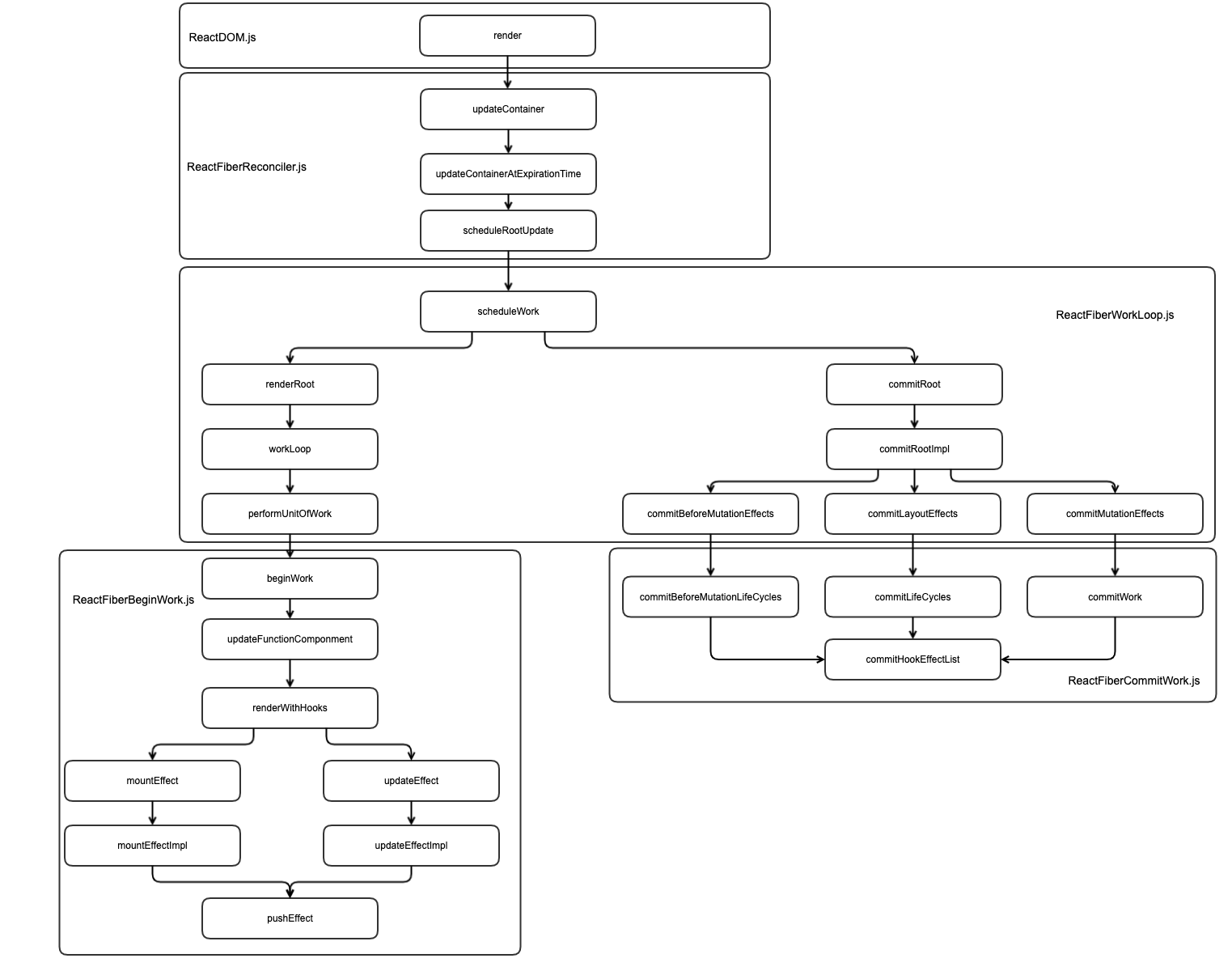
From Part 3, Section 4.3.1, we know renderWithHooks runs during updateFunctionComponent. To trace those three remaining questions, we need to walk through the full Reconciler flow. Fiber is the most complex part of React 16, which is why I’ve been putting it off. There’s enough material there for several posts. Here I’ll sketch out the flow quickly, ignoring unrelated details, focusing only on what happens after useEffect is called.
Note: if you’re not interested in this section, skip to 3.5.
Recommended reading on React Fiber:
3.4.1 ReactDOM.js
The only entry point for page rendering is ReactDOM.render:
ReactRoot.prototype.render = ReactSyncRoot.prototype.render = function(
  children: ReactNodeList,
  callback: ?() => mixed,
): Work {
  // ... irrelevant code omitted
  updateContainer(children, root, null, work._onCommit);
  return work;
};
The core of render is calling updateContainer, which comes from ReactFiberReconciler.js.
3.4.2 ReactFiberReconciler.js
This is the entry point for react-reconciler. updateContainer is:
export function updateContainer(
  element: ReactNodeList,
  container: OpaqueRoot,
  parentComponent: ?React$Component<any, any>,
  callback: ?Function,
): ExpirationTime {
  // ... irrelevant code omitted
  return updateContainerAtExpirationTime(
    element,
    container,
    parentComponent,
    expirationTime,
    suspenseConfig,
    callback,
  );
}
Which wraps updateContainerAtExpirationTime, which wraps scheduleRootUpdate:
function scheduleRootUpdate(
  current: Fiber,
  element: ReactNodeList,
  expirationTime: ExpirationTime,
  suspenseConfig: null | SuspenseConfig,
  callback: ?Function,
) {
  // ... irrelevant code omitted
  enqueueUpdate(current, update);
  scheduleWork(current, expirationTime);

  return expirationTime;
}
The core here is scheduleWork — the entry point for Fiber’s task loop, defined in ReactFiberWorkLoop.js.
3.4.3 ReactFiberWorkLoop.js — Render Phase
ReactFiberWorkLoop.js is 2,900 lines and contains the main task loop logic. Starting from scheduleWork:
export function scheduleUpdateOnFiber(
  fiber: Fiber,
  expirationTime: ExpirationTime,
) {
  // ... irrelevant code omitted
  const priorityLevel = getCurrentPriorityLevel();

  if (expirationTime === Sync) {
    if (
      (executionContext & LegacyUnbatchedContext) !== NoContext &&
      (executionContext & (RenderContext | CommitContext)) === NoContext
    ) {
      schedulePendingInteractions(root, expirationTime);
      let callback = renderRoot(root, Sync, true);
      while (callback !== null) {
        callback = callback(true);
      }
    } else {
      scheduleCallbackForRoot(root, ImmediatePriority, Sync);
      if (executionContext === NoContext) {
        flushSyncCallbackQueue();
      }
    }
  } else {
    scheduleCallbackForRoot(root, priorityLevel, expirationTime);
  }
}
export const scheduleWork = scheduleUpdateOnFiber;
Most branches lead to renderRoot — that’s the entry point for the “render phase” in Fiber’s two-phase model.
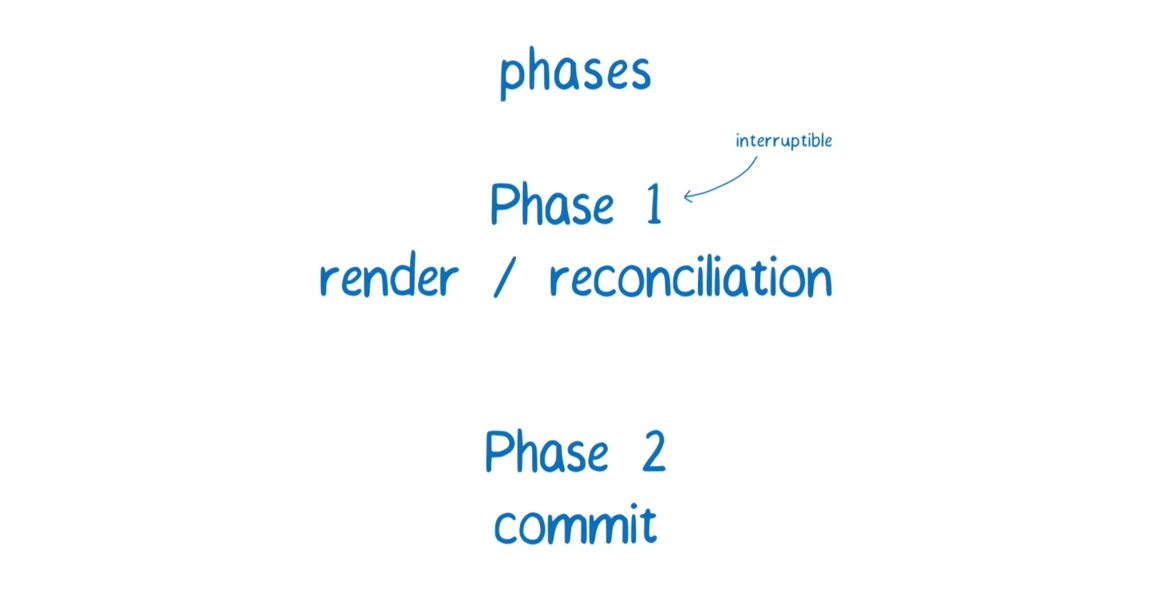
Source: A Cartoon Intro to Fiber - React Conf 2017
You can also observe these two phases when debugging:
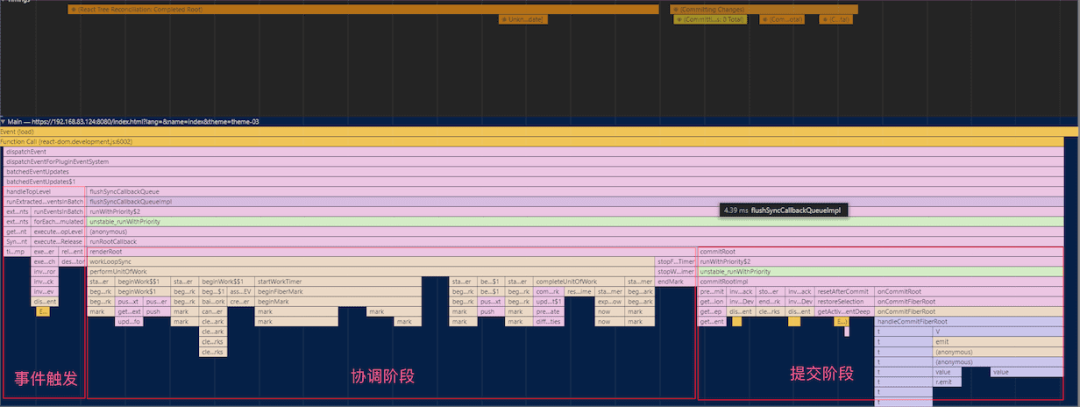
In renderRoot, the key parts are:
function renderRoot(
  root: FiberRoot,
  expirationTime: ExpirationTime,
  isSync: boolean,
): SchedulerCallback | null {
  if (isSync && root.finishedExpirationTime === expirationTime) {
    return commitRoot.bind(null, root); // enter the commit phase
  }
  // ...
  do {
    try {
      if (isSync) {
        workLoopSync();
      } else {
        workLoop(); // core logic
      }
      break;
    } catch (thrownValue) {
      // ...
  } while (true);
  // ...
}
Two key points:
workLoopis the core — a loop that processes work units.- When timed out, it enters the commit phase.
workLoop:
function workLoop() {
  while (workInProgress !== null && !shouldYield()) {
    workInProgress = performUnitOfWork(workInProgress);
  }
}
And performUnitOfWork:
function performUnitOfWork(unitOfWork: Fiber): Fiber | null {
  const current = unitOfWork.alternate;

  let next;
  if (enableProfilerTimer && (unitOfWork.mode & ProfileMode) !== NoMode) {
    next = beginWork(current, unitOfWork, renderExpirationTime);
  } else {
    next = beginWork(current, unitOfWork, renderExpirationTime);
  }

  ReactCurrentOwner.current = null;
  return next;
}
The heart of this is beginWork from ReactFiberBeginWork.js.
3.4.4 ReactFiberBeginWork.js
This analysis mirrors Part 3, Section 4.3.1. At this point, renderedWork.updateQueue (our Effect list) and renderedWork.effectTag are now attached to the Fiber. We skip ahead to see how Fiber processes them.
3.4.5 ReactFiberWorkLoop.js — Commit Phase
Back in renderRoot, when the task times out, it enters the commit phase via commitRoot:
function commitRoot(root) {
  const renderPriorityLevel = getCurrentPriorityLevel();
  runWithPriority(
    ImmediatePriority,
    commitRootImpl.bind(null, root, renderPriorityLevel),
  );
  return null;
}
The real logic is in commitRootImpl. Simplified:
function commitRootImpl(root, renderPriorityLevel) {
  // ...

  let firstEffect;
  if (finishedWork.effectTag > PerformedWork) {
    if (finishedWork.lastEffect !== null) {
      finishedWork.lastEffect.nextEffect = finishedWork;
      firstEffect = finishedWork.firstEffect;
    } else {
      firstEffect = finishedWork;
    }
  } else {
    firstEffect = finishedWork.firstEffect;
  }

  if (firstEffect !== null) {
    do {
      try {
        commitBeforeMutationEffects();
      } catch (error) { /* ... */ }
    } while (nextEffect !== null);

    nextEffect = firstEffect;
    do {
      try {
        commitMutationEffects(root, renderPriorityLevel);
      } catch (error) { /* ... */ }
    } while (nextEffect !== null);

    root.current = finishedWork;

    nextEffect = firstEffect;
    do {
      try {
        commitLayoutEffects(root, expirationTime);
      } catch (error) { /* ... */ }
    } while (nextEffect !== null);

    nextEffect = null;
    requestPaint();
    // ...
  }

  // ...

  return null;
}
When effects exist, there are three processing loops, each calling a different function:
commitBeforeMutationEffectscommitMutationEffectscommitLayoutEffects
The third one is related to useLayoutEffect, so I’ll cover all three in the next post. For now, just know that all three ultimately call commitHookEffectList in ReactFiberCommitWork.js when handling Function Components.
3.5 commitHookEffectList
After all that, we finally arrive at the destination — commitHookEffectList in ReactFiberCommitWork.js:
function commitHookEffectList(
  unmountTag: number,
  mountTag: number,
  finishedWork: Fiber,
) {
  const updateQueue: FunctionComponentUpdateQueue | null = (finishedWork.updateQueue: any);
  let lastEffect = updateQueue !== null ? updateQueue.lastEffect : null;
  if (lastEffect !== null) {
    const firstEffect = lastEffect.next;
    let effect = firstEffect;
    do {
      if ((effect.tag & unmountTag) !== NoHookEffect) {
        // Unmount
        const destroy = effect.destroy;
        effect.destroy = undefined;
        if (destroy !== undefined) {
          destroy();
        }
      }
      if ((effect.tag & mountTag) !== NoHookEffect) {
        // Mount
        const create = effect.create;
        effect.destroy = create();
      }
      effect = effect.next;
    } while (effect !== firstEffect);
  }
}
This is beautifully clear. The Effect list is retrieved from renderedWork.updateQueue. On unmount, effect.destroy runs (the return value of the useEffect callback). On mount, effect.create runs (the useEffect callback itself). All effects are processed in order.
This also confirms our earlier guess: when tag is NoHookEffect, nothing happens.
We’ve now traced useEffect through the source code. One question remains: what exactly does effect.tag do? We’ve only seen the NoHookEffect case — the other values live inside the three functions we glossed over in 3.4.5. Those will be explained in the next post, where we analyze useLayoutEffect.
See you then.
Here’s a flow diagram summarizing Section 3.4: