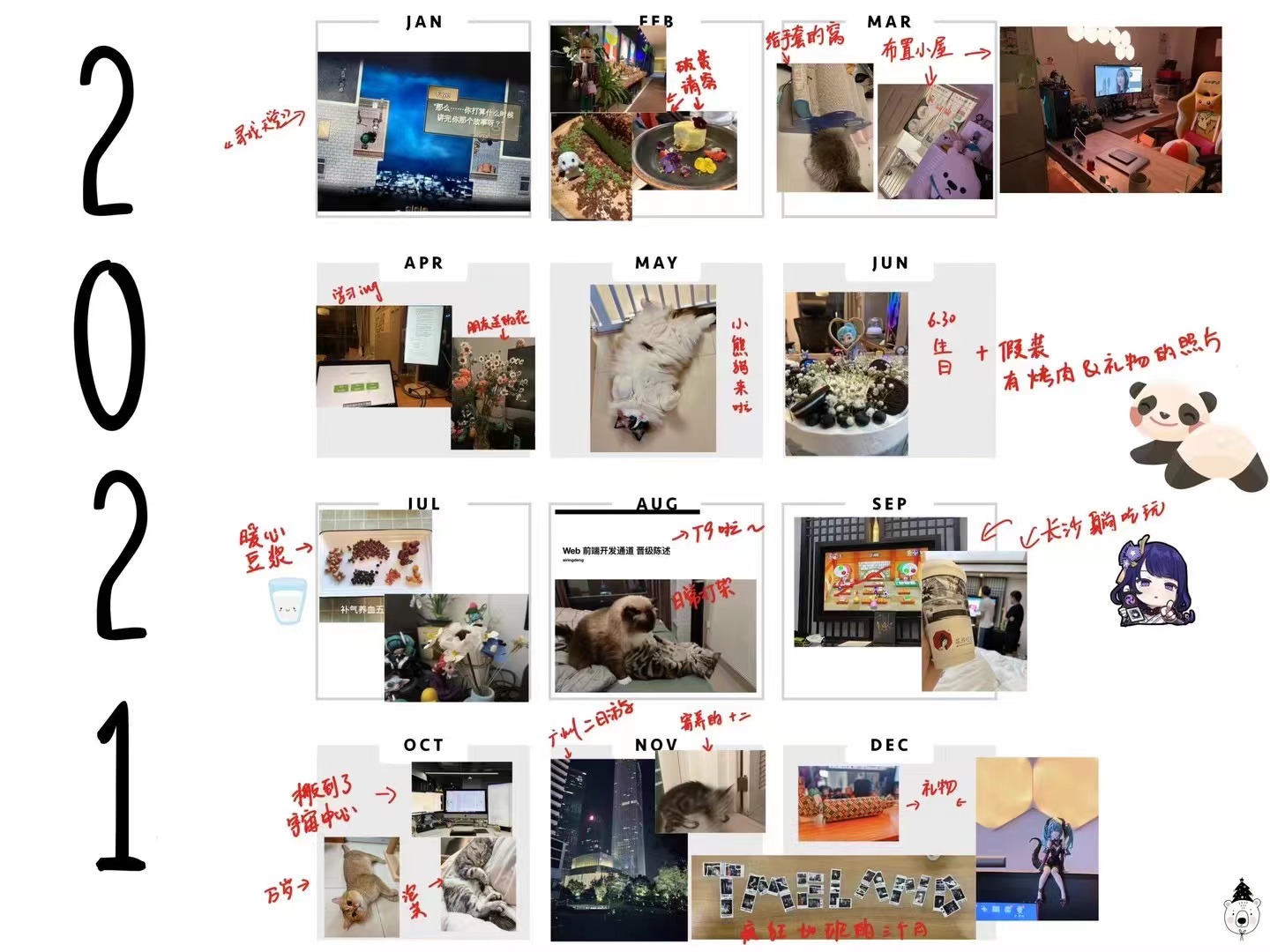
Another year, another review. 2021 felt like it went by so fast that I’m still not sure what to call it. After some thought, “finding my own way forward” feels right. The ancient saying goes: “When things don’t go as planned, look inward.” When obstacles appear, the first response shouldn’t be to blame circumstances — it should be self-examination. This year, my most significant growth came through introspection, and this post is more about reflection than summary. Like Murakami, I’m someone who needs to physically write things down to revisit the past and look at it clearly. The act of writing — and re-reading what I’ve written — makes me feel, as he once put it, as though I’m gradually becoming transparent: “like holding up my hand to the light and finding I can see through it to the faint glow beyond.” I hope keeping this habit continues to push me forward.
Let’s start with work.
Work
The first half of the year was Flutter Kant — completing the development and integrating Flutter into QQ Music. A milestone. After that, opportunities to do client-side development became rare, and I returned to traditional web work.
In the middle of the year, having accumulated three consecutive five-star reviews, I became eligible to be evaluated for promotion to T9. After a month of preparation, I passed — with the highest score in my cohort, which surprised me a bit, though in the end a promotion is just a pass or fail. Before joining the company, I’d never imagined reaching T9 within two years of graduation. And yet here I was, a year ahead of my own target.
At that moment, I experienced the disorientation of losing a goal. If I just reflexively aimed for T10 next year — what would happen if I reached it? What if I didn’t? Did I need to keep chasing?
That was this year’s central work struggle, though I eventually found my way through it. More on that later, in the section on goals.
Midyear, as Ross took over as CEO of TME (Tencent Music Entertainment), an Interactive Live division was formed, and our team moved to the Hexing campus. The second half of the year I led two major projects for the new division: the Lazy Expert initiative and the TMELAND metaverse. These were brutal — cross-department, cross-business-line, cross-company remote coordination, late nights as a given. But by New Year’s, both wrapped up. In the aftermath, I identified two real weaknesses in myself:
- Multitasking: The moment things multiplied, I forgot about priorities. Whoever came to me most urgently got my attention first — cutting into whatever I was already doing without being able to “restore context” after. I’d always worked on focused, research-type projects before, so I could sustain flow states and produce well. But managing a project touching 10 different teams revealed exactly how unequipped I was for this kind of coordination. Hard, but useful.
- Anxiety spirals: When things slipped out of my control, I fell into anxiety, which degraded my output and fed a vicious cycle. I was used to being the one holding the thread — when it left my hands, I didn’t know what to do. This had never really happened to me before: whenever something went wrong (a bad exam, a failed test round), I could always find a corrective path. But I had no experience of situations where control was distributed among many people, none of whom were me.
There were other gaps. Ownership mindset: I had it, but anxiety eroded it. I couldn’t keep it in first position throughout a project.
Both projects finished, but through them I identified where I still need to grow — and knowing where to go is itself a kind of direction.

Year-end brought another five-star — four consecutive now. I can attempt T10 promotion soon. I’m not confident, but the result matters less than what I learn from the process.
Life
In May, my roommate Dingting moved out and my college buddy Jierong moved in. We’d been close in undergrad; reconnecting now feels like a gift.

And then — we adopted a cat from a shelter where Gloves’ sister lives: Xiao Xiong Mao (Little Panda), an aloof beauty born on exactly the same month and day as me.

For a team outing we went to Changsha. We lounged around playing Switch (Switch is definitively not a solo game), drank endless cups of Chayan Yuese tea, and felt wonderfully aimless and free.

I also gave a talk at CVTE in Guangzhou and finally met my friend Shubao in person. We missed the legendary “Motor Canteen” I’d been craving, so we ate at a little bar I’d loved in college — “The Old Tavern.” The taste had changed, though maybe the timing was what mattered: I found out afterward that was its last night open.
Books, Films & Music
Watched a lot of films, anime, and series:
- The Beginning (Kai Duan): Fantastic!
- Demon Slayer: Mugen Train: The only anime that’s made me cry. (QAQ)
- Ranking of Kings: Went viral, which is how I found it. Quality has dropped noticeably in recent weeks — heading toward a disappointing ending.
- Free Guy: Basically a GTA5 movie.
- Departures (Okuribito): A slow, careful work of art. Worth watching more than once.
- Stand by Me Doraemon 2: Watched because of the first one’s quality. Too juvenile.
- Persian Lessons: Beautiful lies told over the bones of atrocity.
- The Odd Family: Zombie on Sale: Classic Korean horror comedy. Watched with my eyes mostly closed.
- Edge of Tomorrow: Another excellent time-loop film. Recommended.
- Tomorrow’s War: …
- Hello World: —
- A Quiet Place Part II: The three-strand parallel cutting is handled beautifully; story itself is a bit thin. Expected something grander.
- Soul: Very aligned with my values.
- Children of the Sea: Ambitious, consciousness-expanding anime — though the director may be reaching for more than the film can hold.
- Inside Out: Extraordinary storytelling and imagination. Spins a little girl’s emotional journey into something that feels like magic.
- Loki: Great MCU villain work — Female Loki is the best!
- The Falcon and the Winter Soldier: Sam’s character arc.
- WandaVision: Absolutely brilliant idea, and only Marvel would dare pull it off. Strongly recommended.
- Godzilla vs. Kong: I mostly remember them fighting. Stop bullying Kong.
- Moon Knight (2022): I remember wasting a Saturday morning.
- Hi, Mom (Ni Hao, Li Huanying): Worth watching with family.
- Okko’s Inn (Wago Ryokan no Oshokuji): A carefully crafted world, lovingly arranged — not quite a fairy tale, but warmer than one.
Didn’t read as many books this year; most were audiobooks I won’t list. But these I read properly:
- Summer Time Rendering: Six stars (out of five). Read the manga in a weekend. A logically coherent, emotionally resonant, supernatural mystery thriller — compulsively readable. Anime adaptation is coming in April!
- The Courage to Be Disliked (Kirai na Kimochi o Motsu Yūki)
- Kokoro (Soseki Natsume)
- Abandoned Cat (Neko wo Suteru) (Haruki Murakami)
Presentations
Besides the CVTE tech talk and some short internal Flutter sessions, I also gave a talk at the Apple Developer Center in Shenzhen for their iOS Club, and I spoke to incoming freshmen in my old undergraduate program. The freshmen talk is the one I want to record here.
I called it: Why Do We Learn?
Three sections: Perception and Reality / Learning Methods / Ideas and Dreams. Three questions:
- Why learn? (Why)
- How to learn well? (How)
- What should we learn? (What)
For the first question, here’s the line of reasoning I followed:
- Started with “Why can’t we perceive the world directly?” — introduced the model theory of how we interpret reality.
- Then asked “Having interpreted the world, how do we evaluate actions?” — introduced the concept of standpoint, drawing on Qi Wu Lun (Zhuangzi’s essay on the equality of things): “Seen from the other side, nothing is clear; seen from one’s own standpoint, knowledge becomes possible.” Only from a standpoint can we grasp anything at all.
- Then asked “Does standpoint really matter?” — examined why we pursue truth, derived a model of how the brain makes decisions.
- Finally, through the proposition “logic is an object falling under a concept,” concluded: “what we can grasp is only the features of individual things — the concrete individual itself cannot be fully grasped. Every concept we form in our minds is the result of countless perspectives fused together.”
From this, four reasons to learn:
- Refine the model: To correctly understand the world we inhabit and build a sound worldview.
- Expand the horizon: To elevate the level from which we see, enriching our historical and cultural perspective.
- Discern right from wrong: To know what is right and have the courage to practice it — and to resist what is wrong.
- Cultivate empathy: To sense the suffering of the world, to feel the emotions of those around you, and to find the beauty and goodness in everyday life.

Goals
Looking back at last year’s goals, most went unmet. I talked this through with a friend: what’s the real purpose of a year-end review? For some people, it’s about identifying last year’s problems, setting targets, fixing weaknesses. For others, it’s pure documentation — capturing vivid scenes before they fade, so that rereading them later brings back the feeling. For me, it’s closer to what I said at the start: reflection, so that future-me can return to these pages and encounter something new each time.

By that logic, flags aren’t that important. But I should examine why I didn’t keep last year’s. I think it was the absence of a regular review mechanism. So this year I want to try specific goals + monthly reviews: goals that are dynamic and short-term (ideally completable within three weeks), paired with monthly retrospective write-ups.
I also want to record some good habits from this year worth carrying forward:
- Fragments, not voids: Outside weekends, I have almost no long stretches of free time, but the walk to and from work is perfect for audiobooks — a full day’s commute is about enough for one book. Articles read on mobile or PC get quickly captured as drafts in Drafts (the app), ready to revisit.
- Periodic integration: The danger of fragmented learning in a fast-paced environment is that you become a “fragmented person” — constantly absorbing without digesting, accumulating without understanding. So every Saturday I clear the week’s Drafts captures and fold them into notes. Fragments collected but never integrated produce only input without processing.

Life goals:
- Cultivate equanimity. Accept success and failure with gratitude and humility. Don’t be moved by desires that aren’t worth it — like the calm Confucius showed when stranded without food at Chencai, like Wang Yangming’s steadiness when told he had failed the imperial exam: “Only being moved by failure would be a cause for shame.”
- Aspire to Su Dongpo’s kind of poetic life — not escapism, but a lightness beyond circumstances, an untroubled tranquility that neither wealth nor hardship can disturb.
- Stay curious, always. Pursue knowledge for its own sake.
Work goal, borrowed from Satoru Iwata (Nintendo’s late president): “Collaborate in a way that makes others say: ‘I want to work with that person again.’”
Finally — here’s to a 2022 in which I can still live with genuine enthusiasm.