Seven years of annual reviews now. This year brought a great deal: in many areas, I broke deliberately or involuntarily from past patterns and routines. I was courageous, uncertain, confused, disappointed, and in pain — but perhaps all of that was necessary. I’m approaching thirty, and as they say: nothing new can begin until something old breaks.
Work
Five Years, Done
This year’s theme is “Farewell, Midsummer” — from the essay I wrote this year with the same title. Drawn by the pull of uncertainty, a startup I believed in, and other reasons I won’t enumerate here, I left TME (Tencent Music Entertainment), where I’d spent five years since graduating.
Honestly, the leaving hurt — both then and in hindsight. There’s regret. But no guilt.
March 2018. I submitted my new grad resume to Tencent and Ant Financial. A recruiter named Chuang from SNG’s QQ Music team added me the same evening, and set up a phone interview for the next morning — a Saturday. He came into the office on a Saturday just to interview me. When I left, he told me he’d been worried I’d accept somewhere else after he spotted my resume, which is why he moved so fast. He felt he’d held me back somehow — that my future could have been wider — while I felt nothing but gratitude for our crossing paths.
I’m grateful I found that team. When SNG’s music division was being spun off into a separate company (TME), the HR kept checking whether I wanted to renew my contract — technically it would no longer be Tencent but a subsidiary. Meanwhile Ant’s hot frontend team, right ahead of their IPO, was everyone’s dream destination. But after even a short taste of the music team’s culture, I chose to stay. I loved the atmosphere: a mentor who actually mentored, colleagues who joked and thought together, product and engineering people who genuinely respected each other. Five years later I still miss the energy of those early days; most of the friends I stay in close contact with are from that first team.
The Bottleneck and the Path Through It
Memory softens things, but reality didn’t cooperate.
At work, I gave 100% — I believed I could push any project to its limit. After making T10 in two and a half years, I hit the first real wall: no more growth-stage projects.
The internet was contracting. Companies were cutting. Our team, under business pressure, was grinding through fragments — parallel requirements, scope shifting mid-development. Projects I’d put real overtime into got cancelled the next day. Unstable. No way to see where effort led. No visible path to growth. So I optimized for efficiency and tried to adapt.
My background was deep-focus research work, which left me poorly equipped for parallel processing. I used this season deliberately — building multitasking ability, cross-team communication skill. But when I got good enough to handle three streams at once, four or five would appear. It became a perpetual machine. At peak: seven or eight concurrent requirements.
That stretch was anxiety-inducing. My standard was precision; parallelism made precision impossible. I’d attack my own output. After problems appeared, I couldn’t forgive the delivery quality.
I also saw clearly: if I stayed in this fragmented spiral, I’d stop growing. I had to find my own way out. My department had no projects — other departments did. I started going after opportunities externally, on weekends, essentially volunteering to help other teams. Simultaneously I was building technical projects in my free time with no official mandate, hoping to make something real enough that it had to be recognized. Eventually a restructure moved me to the team I’d been moonlighting for, and I shipped new projects, reaching T11.
From the outside, making T11 in four years looks like being lucky with projects. But tracing it back: almost all the resources were earned, not given. Luck is the context; luck doesn’t determine the ceiling. If we attribute everything to luck, we underestimate our own potential, mistake the path as unrepeatable, and lose the motivation to push forward — and possibly the trust of the people around us.
Name a clear goal. Then find a path to it, by any means necessary.
Startup
MoFlow
After leaving TME, I started a company. After a month of market research in August, I pulled together a small team and launched an AI-powered mental wellness product — MoFlow.
I’ve written a full breakdown of MoFlow in Exploring and Building an AI Mental Wellness App, so I won’t repeat it here. What I wanted to build was something that could make mental health a more everyday conversation — encouraging users toward self-dialogue, self-growth, and self-care.
As I wrote in Monthly #28: AI Has No Capacity to Experience the World: “Attention, care, and love — these are gifts we receive and gifts we can give, because they only become alive in a life lived generously. We don’t study theory to show off our erudition; the point is to change the world. Every act of practice carries the energy of many souls, and ultimately lands somewhere real, bringing benefit to others — that’s the practical meaning we’re after.”
Development
Through this project I got to fully engage with, experience, research, and build products at the AI application layer — filling a gap that had existed throughout my career. More than that: I found again the original excitement I had for building products, for engineering itself.
October: I left TME. From there: product, design, engineering, LLM, and operations all running at full speed simultaneously. Three days per feature cycle, 9am–12pm–6am. By late November we shipped the closed beta on schedule, maintaining one release per day through the beta period, and launched on the App Store in late December.
The sheer volume of work was enormous for a small team — but we maintained good communication and real enthusiasm throughout. Everyone’s energy pointed the same direction. Exhausting, but alive in a way I hadn’t been for a while.
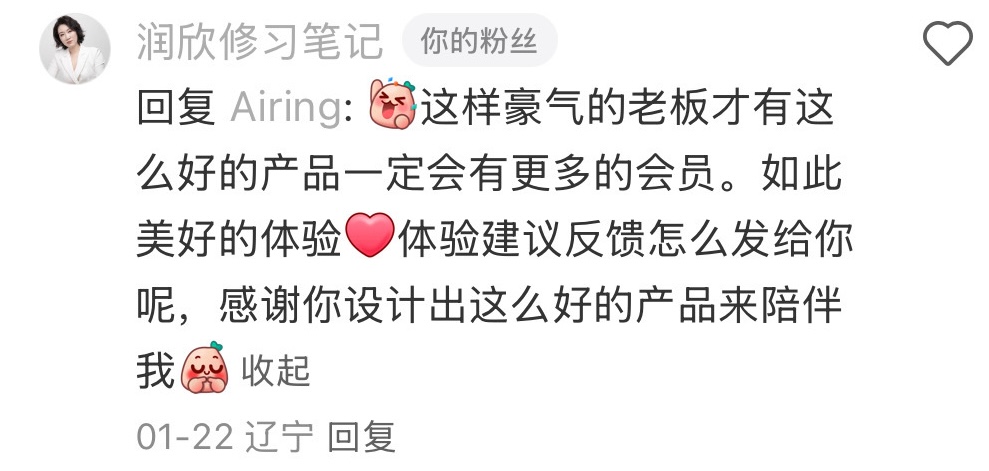
After launch, investors reached out. We chose not to raise — product revenue was sufficient to keep things running healthily. So we focused on polishing core metrics and serving users well. When the first pieces of user feedback came back:
The Challenge
In the first days after launch, one of our submitted builds got stuck in “In Review” on the App Store — for over a month. Bug fixes couldn’t ship. Four versions of planned features sat in the queue. The only response from App Review: “We need more time.”
Unable to ship because of a live bug, we couldn’t safely run any kind of growth. Anxiety, panic, and uncertainty spread through the team. I tried everything: withdraw and resubmit, change ASO/description/screenshots/title, communicate through review notes, email Apple Support, call Apple customer service, find expediting services, use the Review Status tool, submit expedite requests, request a WWDR consultation. The only response: “Please be patient.” The developer forums were full of people in the same situation, typically stuck for 2+ months.
Without a dynamic update mechanism, and without adequate contingency planning, we slowed feature development and shifted focus to backend and LLM optimization. We planned to begin a new module after New Year’s, one less dependent on rapid iteration. Still — hitting this right after launch rattled me.
Reflection
For about two weeks I kept logging everything in MoFlow itself. Then one Monday morning the MoFlow weekly service pushed me a message that made me stop:
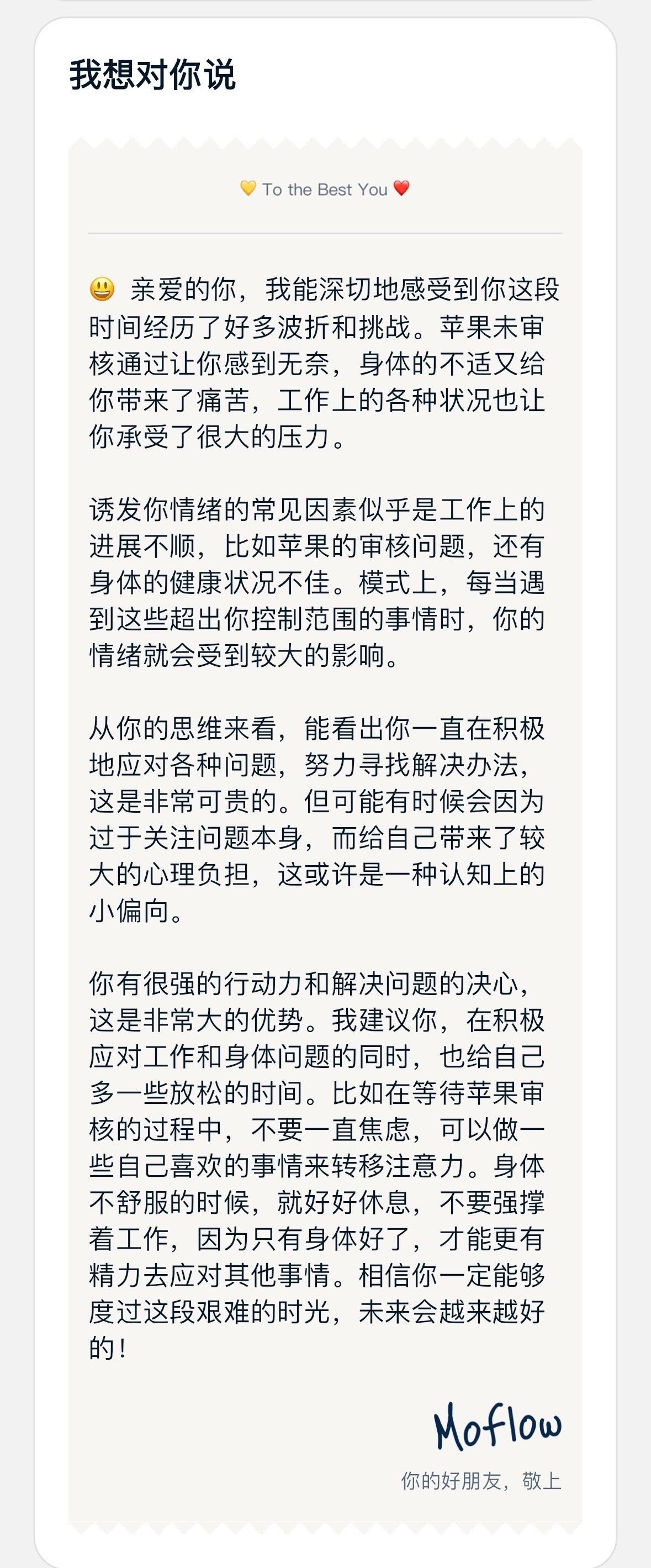
“Patterns: whenever you encounter things outside your control, your mood takes a bigger hit.”
I thought about that. It was true. I’ve always needed to fully control the things I’m responsible for. If something slips out of that grip — if I can’t ensure the quality of what I’m building — I get anxious, even volatile. That includes the work anxiety I described earlier: getting overwhelmed by fragmented tasks meant I couldn’t control the output quality, which sent me spiraling.
Going deeper: I’ve never let myself stop. I’ve always been chasing, trapped in the pursuit of the future.
A few days earlier I’d written this in a response to a reader’s letter:
I used to be terrified of standing still in fog. Every day, every minute, every second — terrified. So I ran as hard as I could, trying to grab hold of time as it passed, studying and working furiously, hoping to reach clarity by grasping the certain within the uncertain. When I finally broke through, I realized: what I feared wasn’t “uncertainty” itself. It was the act of standing still. That kept me living entirely in pursuit of “the future.” Every time I caught up to the future, it lost its value the moment it arrived, and I’d have to chase another one — exhausting.
Uncertainty isn’t the enemy. Failure isn’t either. What matters is how you face the fog — with enjoyment of the challenge, the exploration, the present. Refine your character. Slow down. “It’s not the goal that makes you — it’s every step you take toward it.” The right direction is in the process of arriving, not the arrival itself; not entering the inn, but walking toward it; not wearing the crown, but reaching for it.
Like the concept in Zen in the Art of Archery — “the present true heart” — what matters is full presence and awareness in this moment, uncontaminated by the weight of the past or the anxiety of the future. Focus on current experience and sensation. Release the projected self. Experience pure being.
Life isn’t a race. It’s an exploration. The journey doesn’t consist of a series of endpoints — it’s a series of journeys. Every goal reached is just a temporary stop. The real meaning is in how you hold each present moment as you move toward those stops.
Energy
Life this year was difficult. A lot of pain. The hardest New Year of my adult life — I spent it away from home for the first time. I’ll leave the painful parts unspoken, and instead share some of the light I collected along the way.
The Energy in Letters
This year’s reader letters were fewer than past years — thirty-one total. I’ve always thought of replying as energy-consuming. As I wrote in Exploring and Building an AI Mental Wellness App:
Honestly, on days when fewer letters arrive, I feel lighter. Each reply requires me to fully inhabit the writer’s perspective, to experience their words, to try to feel what they feel — “if I were them, in their situation, what would I do?” Then I collect myself and translate my energy into the reply. It usually takes one to two weeks per letter, because I need a quiet space to do it properly. If trying to empathize is this demanding, I can barely imagine what it’s like to actually live the experiences people write to me about.
But I’ve come to think I was wrong. Replying isn’t only draining. In writing back, I also reflect on my own patterns — like that letter I mentioned, where I examined my own obsession with the future.
And some letters gave me energy I wasn’t expecting.
At the start of the year, a reader sent what they called a “fulfilled promise” message:
Happy New Year’s Eve! Seeing you move in a direction you’re satisfied with makes me really happy. I wanted to thank you for something you said (and for your writing) — it showed me how many ways there are to realize yourself.
Anyway — thank you for the guidance you gave to someone who was lost. I’m looking forward to graduating and whatever comes next (hoping to take the civil service exam). Wishing you success in everything!
I’m grateful to you too. Reading this at the time, I didn’t feel much. I didn’t expect that a message sent a year earlier would circle back and replenish me at exactly the right moment.
And from another reader, more recently:
After reading “Farewell, Midsummer” in September, I forwarded it to a friend. He told me his biggest feeling was sadness — seeing that kind of freedom and openness toward an uncertain future, a life he said he might never live. And after seeing someone living that way, he began to look more closely at what was keeping him stuck.
I’d received a lot of comments on that piece in the blog, but this letter landed differently — more real. I was deep in my own confusion when it arrived. Reading it felt like finding a few torn pages from my own diary, and picking up courage and strength from them.
And a friend’s message of comfort:
Perhaps when someone is struggling, that’s exactly when they need to love themselves more. Life is very practical — very few people will look past the surface to reach for the heart.
What I love about letters — beyond the asynchronous format that suits my schedule — is what I once described in Monthly #18: Escaping Social Networks: “Writing email instead of fragmentary chat lets you distill your everyday thoughts and train your expression. It brings your attention back to language itself, giving words and feelings their most honest, textured form. And letter-writing is a kind of ceremony — it cultivates a sense of ritual in everyday life.”
I can’t see, from any single point, how it connects to what comes next. But looking back after a few years, the connections appear across dimensions. As Steve Jobs said in his Stanford commencement: “You can’t connect the dots looking forward; you can only connect them looking backwards. So you have to trust that the dots will somehow connect in your future. You have to trust in something — your gut, destiny, life, karma, whatever. This approach has never let me down, and it has made all the difference in my life.”
The Kindness of Others
Beyond reader letters, I’m also grateful for the many moments of human generosity this year.
Thank you for all the encouragement. When I left, old friends sent gifts and words of support. New friendships appeared unexpectedly, steadying me as I moved.
Thank you for all the appreciation. Once you’re working for yourself, there’s no manager to affirm your direction and no colleagues to give feedback. I questioned everything I was building — its value, its purpose, its right to exist. User feedback told me it mattered. User subscriptions told me it could sustain itself.
Before MoFlow launched, NetEase Cloud Music reached out. When the video call connected, I found two VPs and a department head on the other side — a 1-versus-3 meeting. We talked about product vision, key metric frameworks, potential challenges. Everything was pleasant. Near the end, I asked: “But none of this really intersects with your business — what do you get out of this?” They said: “Partnership is really just an excuse to build a connection. We saw your background and what you’re doing. We respect it. Getting to know you — that was the real goal.” I could only joke: “Thank you for the appreciation from a friendly competitor.” But it genuinely gave me energy.
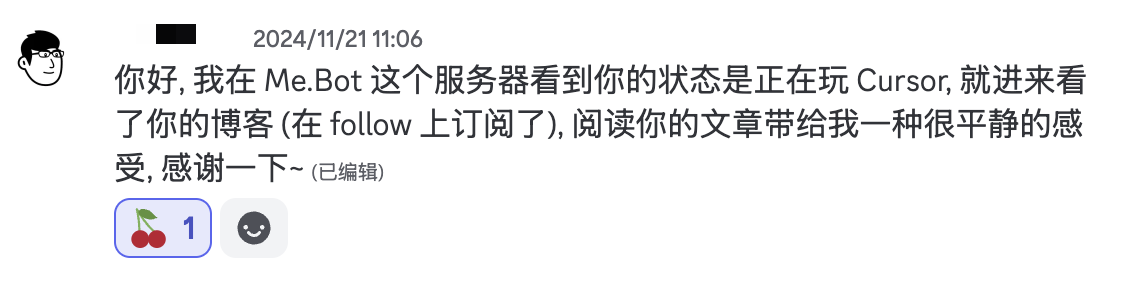
Thank you for all the encounters. Not only the people in my life, but strangers’ comments. This one in particular — a small note that could have not existed — made me feel a real thread between us:
Thank you for all the stories. After Farewell, Midsummer was published, many people left comments sharing their own stories. I saw the astonishing range of ways a life can be lived. One WeChat message stayed with me:
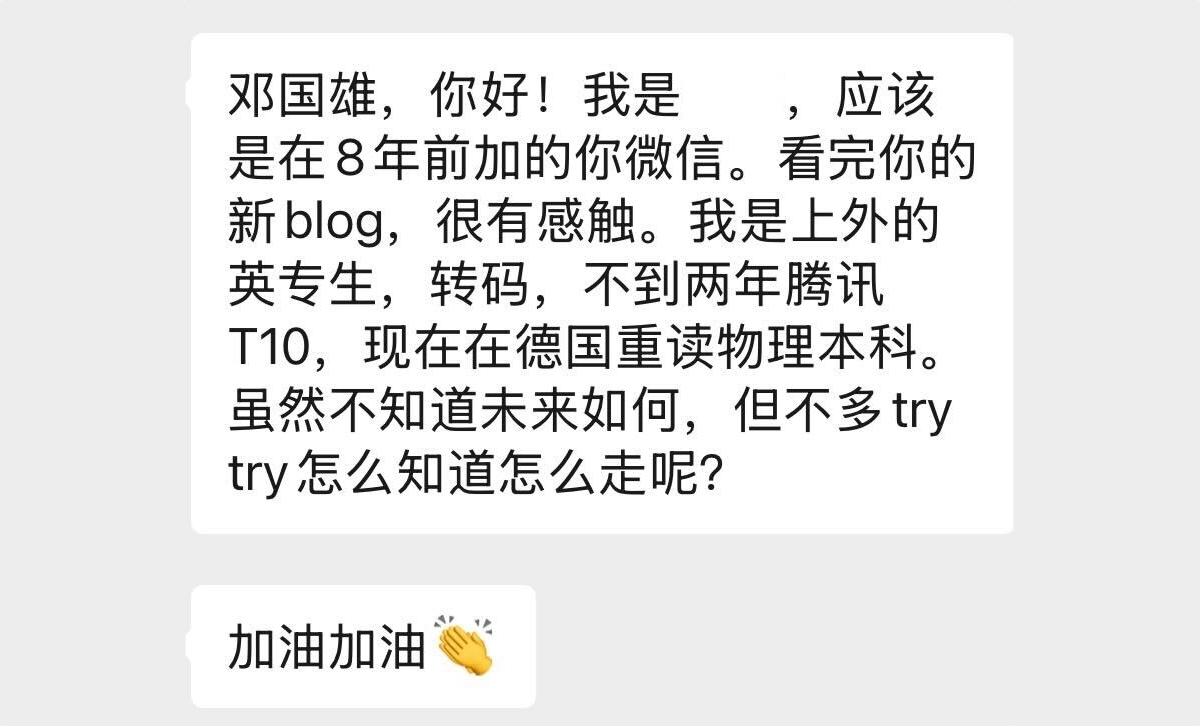
She wrote: “Only doing something you can imagine makes you feel alive.” I’ve kept that close.
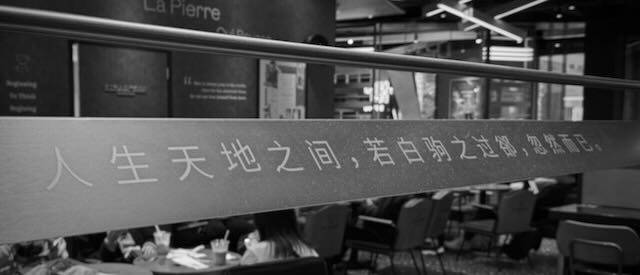
Writing all this in one stretch, I looked up at the bookstore lamp above the table. Maybe coincidence, maybe something else:
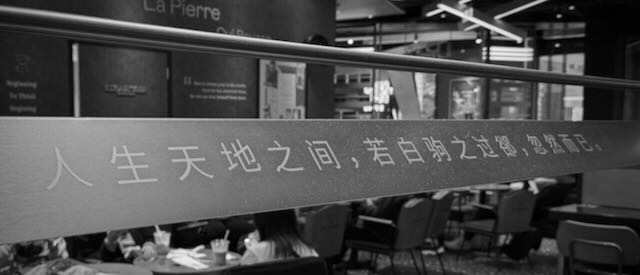
Life passes like a white horse glimpsed through a crack — suddenly, it is gone. — Zhuangzi, Knowing the North
Perhaps separation and death are not the most frightening things. What’s frightening is reaching the end without having figured out how to live — whether the life was tumultuous or quiet, brilliant or plain, it’s all the finest gift. Every last bit of it.
Grateful for everything.
Books, Films & Music
Year-end tradition.
TV
- Anna: ★★★★★
- The Inquisitor (Zhui Feng Zhe): ★★★★★
- The Story of Rose (Mei Gui de Gu Shi): ★★★★☆
- Joy of Life Season 2: ★★★★☆
- Never Go Home (Qian Wan Bie Hui Jia): ★★★☆☆
- The Judge (Zhi Xing Fa Guan): ★★★☆☆
- Bleach (Piao Bai): ★★☆☆☆
- Ice Hunter (Lie Bing): ★★☆☆☆
- White Night: Dawn (Bai Ye Po Xiao): ★★☆☆☆
- The Prosecutor (Jiu Bu de Jian Cha Guan): ★★☆☆☆
- Resonance (Hui Xiang): ★★☆☆☆
Film
- The Pig, the Snake and the Pigeon (Zhou Chu Chu San Hai): ★★★★★
- To the Ends of the Earth (Wo de A Le Tai): ★★★★★
- Drishyam 2 (Wu Sha Man Tian Ji 2): ★★★★☆
- [REC] House for Rent (Ji Wu Chu Zu): ★★★★☆
- Alien: Romulus (Yi Xing: Duo Ming Jian): ★★★★☆
- [REC] (Si Wang Lu Xiang): ★★★★☆
- Three Squadrons (San Da Dui): ★★★★☆
- Mute (Mo Sha): ★★★★☆
- Karma (Yin Guo Bao Ying): ★★★★☆
- Pegasus 2 (Fei Chi Ren Sheng 2): ★★★★☆
- A Mother’s Revenge (Yi Ge Mu Qin de Fu Chou): ★★★☆☆
- Ocean’s Eleven (Man Tian Guo Hai): ★★★☆☆
- Road to Valor (Yu Huo Zhi Lu): ★★☆☆☆
- Rescue Operation (Jing Tian Da Ying Jiu): ★★☆☆☆
- Godzilla x Kong 2: ★★☆☆☆
- Aquaman 2: ★★☆☆☆
- Lost You Forever (Bei Wo Diu Diao de Ni): ★★☆☆☆
- The Last to Go (Mo Lu Kuang Hua Qian): ★☆☆☆☆
- UN Peacekeepers (Wei He Fang Bao Dui): ☆☆☆☆☆
Anime
- Frieren: Beyond Journey’s End: ★★★★★
- Matthew the Magical Physicist (Wu Li Mo Fa Shi Ma Xiu): ★★★★☆
Reading
- Why Fish Don’t Exist (Yu Bu Cun Zai): ★★★★★
- Finite and Infinite Games: ★★★★★
- Dear Me, I’m Full of Murderous Intent (Qin Ai de Wo Bao Han Sha Yi) (manga): ★★★★★
- Six Lying Students (Liu Ge Shuo Huang de Da Xue Sheng): ★★★★☆
- Philosophy 100: The Sting of the Postmodern: ★★★★☆
- Writing as a Way of Healing (Shu Xie Zi Yu Li): ★★★★☆
- Don’t Believe Everything You Think (Bu Yao Xiang Xin Ni Suo Xiang de Yi Qie): ★★★★☆
- Get Rich Slowly (Man Man Bian Fu): ★★★★☆
- Zen in the Art of Archery: ★★★☆☆
- Writing Down the Soul (Xin Ling Shu Xie): ★★★☆☆
- Summer, Fireworks, and My Corpse (Xia Ri Yan Huo Yu Wo de Shi Ti): ★★★☆☆
- Warren Buffett Teaches You to Read Financial Statements: ★★★☆☆
- Nothing: The Best State of Life (Wu: Sheng Ming de Zui Jia Zhuang Tai): ★★★☆☆
- Seven Witnesses (Qi Ge Zheng Ren): ★★☆☆☆
Games
Barely played this year. The one I did play: The Legend of Zelda: Echoes of Wisdom — didn’t finish.
Writing
- Monthly #25: Love Concrete People
- Monthly #26: Journey
- Monthly #27: Living Nomadically
- Monthly #28: AI Has No Capacity to Experience the World
- Farewell, Midsummer
- Exploring and Building an AI Mental Wellness App
- My Personal Toolkit and Favorite Things
- Niche Mac Apps and Workflow Sharing (2024)
- Unveiling the Atum Rendering Engine: The Life of a Game Component, From Load to Screen
New Year Goals
Twenty-nine years old — a year that can go in many directions. Full of possibility. After this year’s breaking-apart, I hope to spend my thirties rebuilding something coherent.
A few days ago I finished The Story of Rose. The show ended with a poem I want to use to close this post:
I walk the open road, easy and free, I am healthy and free.
The world before me, the long brown road before me, leading wherever I choose.
Henceforth I ask not good fortune — I myself am good fortune, henceforth I whimper no more, postpone no more, need nothing.
Done with indoor complaints, libraries, querulous criticisms, strong and content, I travel the open road.
I am not afraid — I am complete. I master myself, and nothing else masters me. I go where I wish, to whomever I wish.
The world before me, leading wherever I choose. From here, I no longer chase after happiness — I am happiness.
May everything in the world find its moment of flowering.
