Why I’m Starting a Newsletter
The posts on my blog tend to be long and heavy — usually 4,000 words or more. Because I care about quality, writing each one takes a lot of energy and time, and that creates a kind of pressure that makes it hard to write consistently.
A couple of years ago I set a goal to publish one post a month, but I only kept it up for six months before it fell apart. Once work got busy, I couldn’t carve out the long, uninterrupted stretches of time needed to sit down and actually write. Looking back, the only periods when I could reliably produce writing were during national holidays — May Day, National Day. That made my output rate way too low, and the topics too narrow, which defeated the whole purpose.
In my 2021 Year in Review I described my knowledge pipeline: I use Drafts to capture quick highlights while reading — “fragment intake” — and then do a “periodic consolidation” once a week, organizing everything into LogSeq.
Here’s a screenshot of what those notes look like after a simple pass:
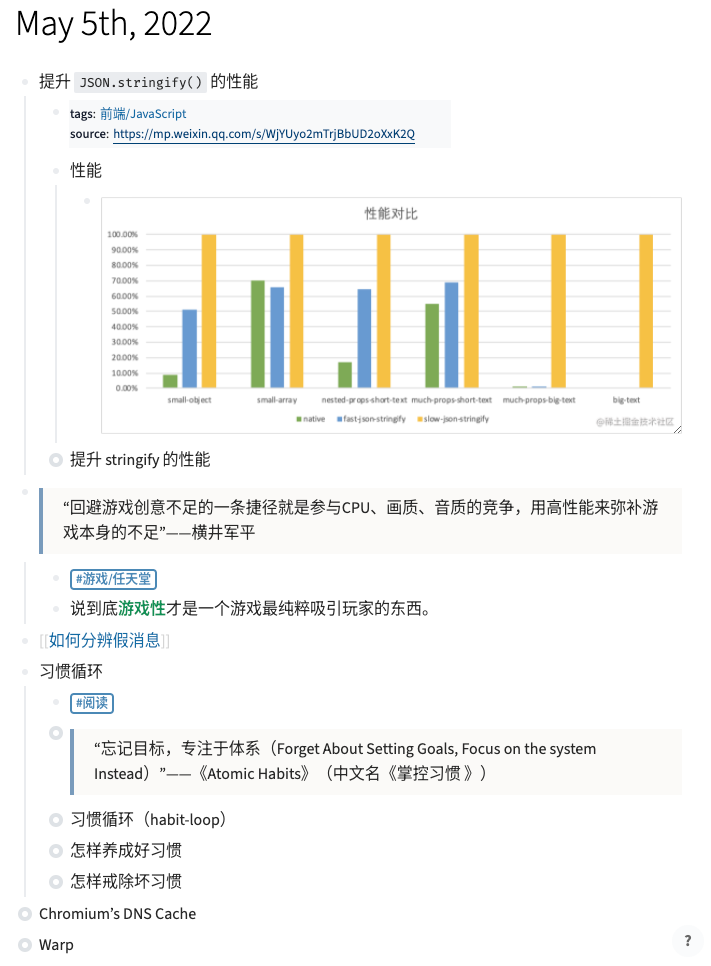 But I’ve come to realize that this is still just input. I haven’t been pushing my thoughts outward into real output. Friends have complained that I don’t produce much. Blogging is my preferred output format, but I want something lighter and more frequent — something like how I used to write back in 2014–2017, when my old blog was full of casual essays, unpolished and unguarded.
Last week I stumbled across something on my blog that surprised me: one of my readers runs their own weekly newsletter column, and I found a few others who do the same kind of weekly writing — combining a bit of depth and reflection with regular sharing. I really love that format.
The easiest way to make reading useful is this: the moment you have an insight or idea, write it down immediately and post it publicly on social media, even if it’s unpolished. The act of writing is itself a step in deep thinking. Valuable feedback from others can help you refine the idea or give you new threads to pull on. Accumulate enough of this and real insights will emerge naturally. Reading and taking notes alone, in isolation, rarely sharpens thinking quickly. — Silicon Valley Wang Chuan on Weibo
After all that thinking, I’ve decided to start a newsletter. I might miss an issue here and there, but now that I’ve started, I’ll use this regular rhythm to keep pushing myself forward. For me, it serves two purposes: it pressures me to keep my input high quality, and it closes the distance between me and my readers. I’ve noticed that my blog has both tech posts and personal/life posts, but readers tend to prefer the personal ones — especially my annual year-in-review posts, which always get the most traffic. Some readers remind me every December not to be late with the year-end summary. Ha.
So, the motivation is there. What will I actually share?
If the newsletter is just a pile of notes and recommendations with no real substance, it won’t serve the purpose of genuine output. So each issue will have two parts: a Featured Topic and Weekly Picks.
- Featured Topic: A central theme for the issue. This is the main body of the newsletter — my observations and thoughts on that theme, written like an essay. This issue’s featured topic is, naturally, “why I’m starting a newsletter.”
- Weekly Picks: Split between tech and life. On the tech side: useful tools I’ve found, high-quality articles, interesting technical problems I’ve run into at work. On the life side: personal experiences, things I’ve been reading, and whatever’s been on my mind.
And now, on to the recommendations~
Weekly Picks
On Expiration Dates
I finished reading Paradox 13 last week. In that end-of-world scenario, the main characters face a food shortage and spoilage problem, which made me think of this line from Chungking Express:
I don’t know when it started, but everything has a date stamped on it. Canned sardines. Canned ham. Even plastic wrap. I started wondering: is there anything in this world that doesn’t expire?
Is there anything in this world that doesn’t expire? Nothing lasts forever.
On Nintendo’s Games
I came across a great video about Nintendo this week. When people talk about Nintendo games, one word always comes to mind: fun. And it was Gunpei Yokoi who laid the foundation for Nintendo’s design philosophy:
“An easy shortcut to compensate for insufficient game creativity is to compete on CPU performance, graphics, and sound — using raw hardware to paper over a game’s weaknesses.” — Gunpei Yokoi
At its core, gameplay is the purest thing that draws players in. Nintendo’s strategy of expanding its audience means their games are designed for everyone — including young children. On this point, Reggie Fils-Aime, then President of Nintendo of America, said in an interview with the Toronto Star:
“We’re very happy that our competitors don’t focus on the kids’ and family game market. It’s actually a very important market, because the 5- and 6-year-olds of today will grow into teenagers and adults who remain our loyal users. And when you play Kirby, The Legend of Zelda, or Mario Kart with your family, it brings you closer together.”
It’s hard to imagine a company like Nintendo emerging from China’s gaming environment. Game licenses get restricted by government policy; a single directive can wipe out an entire genre of business overnight. Everyone’s anxious, and the rules are opaque — the more unpredictable the rules, the more powerful the threat. So developers chase quick money, endlessly iterating on monetization schemes. Real quality, it seems, can barely take root.
Recommended watching:
