This issue covers April and May 2026.
A Month of Vibe Coding
This past month I went on a vibe-coding spree — 25.7 billion Claude Code tokens spent in total:

Almost all of those were burned across six weekends, because weekends are the only stretches I have for messing around (otherwise a 20x plan would only last me three days).
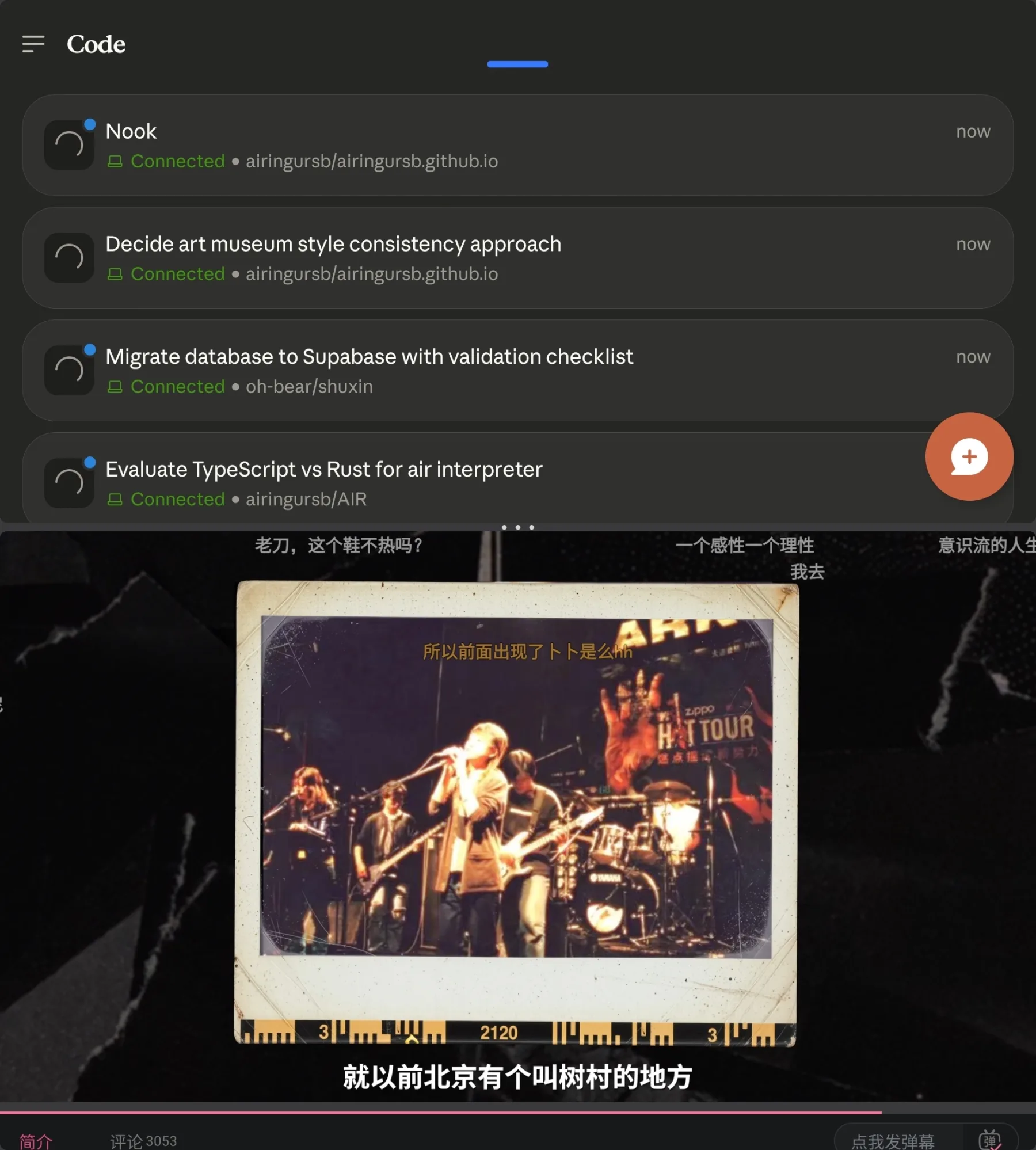
I usually have at least seven long-running tasks going at once in Claude Code, and I’m not glued to my desk the whole time — my Samsung small foldable phone is fantastic for this. I can be anywhere, watching short videos with one eye while keeping the other on the agent dashboard. The moment an agent stops, the phone catches it first; voice input keeps them moving (the ruthless boss can’t let them rest):

So what got built across those six weekends? Let me share it in this issue.
Some Small Toys
I polished the blog a bit, added multi-language support, and shipped a few new modules:
Workouts:

A photo wall:

And a comics pipeline: I set up a workspace that locks in my own character and art style, so I only need to say one sentence to the agent each day (optionally with photos — it style-transfers and anonymizes them), and it auto-generates a 4-panel strip and publishes it ——

Sharing turned out nice too:


I also wired up analytics. The site does about 10K PV/month right now:

The App
Following up on last issue’s finance app: I added quite a bit — AI voice input for transactions, OCR receipt capture, position tracking and analysis, and a family-shared ledger that took me a long while to get right.

MoneyWise is now live on iOS, Android, and macOS, and it has fully replaced MoneyWiz which I’d been paying for for years.

The whole journey from development to App Store didn’t take much time — design, dev, ops, and the store-listing materials were all handled by Professor Claude.
14 Deep-Dive Articles
This period I shipped 14 new immersive technical longforms. Each one is an encyclopedic deep dive, paired with rich visualizations and interactive learning. Studying this way turned out to be remarkably efficient:
- The Life of Bytecode to Pixels — A Tour of Chromium’s Rendering Pipeline: I originally wrote this in 2022, which back then took me a month — I had to spin up the Chromium project and step through it line by line, hand-drawing the logic chains. Not anymore. Claude spent one day rebuilding that article with much better visualizations and deeper explanations.

And 13 others, written-while-learning, with both learning efficiency and output at maximum:
- Measuring “Smoothness” — From FrameTime to Stutter
- Extreme JS Performance — V8’s Optimization Principles and the Reincarnation of a Hot Function
- Sedimented Pixels — A Full-Spectrum Encyclopedia of 50+ Image Formats
- The Life of One Request — HTTP/3 in Full
- From Rust to SIMD — The Life of WebAssembly
- The Life of One JS Line — A QuickJS Source-Level Walkthrough
- The Life of One setState — A Tour of React’s Render Pipeline
- Helio: The Evolution of a High-Performance Mini-Game Container
- Many Ways to Die — Family Tree of 11 GC Algorithms
- Eight Translations of One Dispatch — A WebGPU Stack Source-Level Walkthrough
- The Life of One CSS Rule — A Tour of Chromium’s Style Engine
- The Life of an LLM Inference
- The Life of a TLS Handshake — TLS 1.3 Protocol in Full
Claude even went one step further with the GC piece and turned it into a 3D game that explains each GC algorithm through gameplay:


A Homemade Programming Language —— Penelope
In Homer’s epic, Penelope waited twenty years for Odysseus. By day she wove a shroud; each night she secretly unraveled the day’s work. She wasn’t unable to choose — she was unwilling to. She was waiting for someone who hadn’t come back.
After that story rolled around in Claude’s head for a long while, it suggested I turn it into a programming language.
Anyone who writes code is familiar with this predicament: the programs you write have no patience for waiting. The moment a process is interrupted, everything in its head — the stack, the variables, the line it was on — is gone. To make programs survive waiting, we wrap them in scaffolding: checkpoint files, message queues, idempotency keys, retry logic, durable-execution frameworks like Temporal or Inngest. They work, but they all extract the same cost — you have to translate what you want to do into what the framework will let you say, slicing your code into activities, steps, and awaits.
Penelope’s idea is plain: pull all of that back into the language itself.
let x = 10;
let y = pause;          // process exits here, state writes to disk
print(to_str(x + y));   // an hour later, a week later, a year later,
                        // another process picks up and prints 15
No await, no checkpoints, no decorators. Just one keyword pause, on equal footing with let. Underneath it sits a single axiom ——
Execution is data. A running program is itself a value.
Penelope ships with a self-implemented bytecode + VM execution, a debugger, an LSP, a VSCode extension; for performance, both JIT and a WASM backend are supported. On top of all this, the language is now self-hosting — the new lexer, parser, and compiler are all written in Penelope itself.

By making pause a first-class expression, Penelope rewinds an engineering problem all the way back to a semantic one.
In the process, I shored up my own programming foundations, and along the way realized something about Professor Claude’s reasoning: when the reasoning capacity is strong enough, the higher-level usage might actually be subtraction — push back to the most solid base point, and then go forward together with it doing addition. Knowledge absorbed that way is denser in value and far more durable.

A Living Stardew Valley
This project’s origin: after I added i18n to the blog and a real-time online presence indicator, I noticed quite a few overseas visitors landing on the site, some of whom were happy to comment, which kept the traffic flowing. There were even a few days when the free Supabase tier started to choke:

So I thought — why not just make a game? Represent visitors as little animals, put them all in a shared room interacting with each other, give it a “the world is one village” feel:

Because the image-2 results were great, I splurged on Codex too, and had Claude Code and Codex team up to build the game:

The little game kept growing. Every NPC is wired up to AI, and borrowing from OpenClaw’s architecture, each has its own SOUL and independent memory system — if you sign in, it stores memories specifically about you, and occasionally sends you check-in emails on its own initiative. A living Stardew Valley:

The creative momentum is real and just keeps coming. For example, right now I’m building a chaotic exhibition hall for my own work — I’ve rebuilt it several times and still not happy with it:

I’ll hold back the 2D world’s link for now — there’s still plenty I, the creator-god, need to fix up first.
3D Game Explorations
If the above was the 2D direction, this section is the 3D direction. Besides the GC game already mentioned, I also built a 3D zen miniature world:

It’s still being polished, but you can already get a taste: https://ursb.me/world/. You can play white noise, set a Pomodoro timer, and there are subtle wind animations throughout — it has a real atmosphere to it.
3D gaming took me down plenty of dead ends. For instance, I tried for a long time to build this “chatting under a tree” scene, and after all that effort this was the result:

Avatars in particular burned a lot of my time and money. Diffusion model outputs are like a blind box — never quite what you want.

But if you just let the coding model handle the art assets, you get this:

There’s still plenty more I want to make — I’ll save it for another issue.
🌺 Life Moments
⛰️ MacRitchie Hike
https://ursb.me/workouts/521415AA-9098-4F05-96D8-AF11B5893821/

🗡️ The Holy Sword Microphone
I built myself a holy-sword-shaped microphone:

⌨️ ZSA Voyager + Navigator + ZSA Moonlander
Recently retired my HHKB series after over a decade of use, and picked up a ZSA Voyager + Navigator. The split keyboard took me two weeks of practice just to barely type again… but once it clicks, it’s wonderful. So I went and bought a ZSA Moonlander too.
My desk’s a mess right now, so I’ll go with a stock photo this issue — looks roughly like this:

🎮 Roco Kingdom
I’ve been hooked on Roco Kingdom lately, and caught a shiny-pink Snowshade Doll variant:

🎬 Books, Films & Music
What I consumed this period:
- Watched: TV | Fatal Wish | ★★★★★
- Watched: TV | Extraordinary Attorney Woo | ★★★★★ | second rewatch
- Watched: Film | Sacrifice Hill | ★★★★☆
- Watched: TV | The Boys: Season 5 | ★★★☆☆ — disappointing ending.