← Weekly shelfIssue 004
中 EN
NO. 0042026.10.11—10.17

AI Trends Weekly

Every Monday · Understand what is changing

Airing, a panda in a blue beret, checks progress, evidence and next steps at an editing desk; AI concept illustration.

COVER STORY · PERSISTENCE & HANDOFFS

Agent

Always on.
Ready to hand over?

Leave progress, evidence and a next step
The panda’s desk · AI illustration

AGENT ENGINEERINGScion: when code scales

RESEARCH & TOOLSResearch agents · 5 tools

AIRING’S READING DESK

004

Always on.
Ready to hand over?

AI is staying at its desk. This week, we ask what it should leave behind so someone else can confidently pick up the work.

Editor
Airing ↗
Reading period
2026.10.11 — 2026.10.17
Publication date
2026.10.19Every Monday
Inside
34 saves · 5 themes32 in the period + 2 Sunday additions

EDITOR’S GUIDE

Get one handoff right before building a team of agents. Leave progress, evidence and a next step.

From Airing’s reading streamReadings, supporting references and image credits included.

01

Personal agents

From persistent agents to durable tasks: ownership, acceptance and continuity.

COVER STORY

Hand it off so someone can take over

Persistence keeps work running. A handoff lets someone accept the result.

An always-on computer is not yet a dependable colleague

This week’s personal agents share a move: taking AI out of a single conversation and giving it a computer that stays online. After you leave, it can organize files, run programs and wake for a scheduled task. Founder Park surveys products living in apps, messages and email, or presented as teams of named bots. Underneath, their foundations increasingly resemble one another: a cloud computer, persistent memory and connections to other tools. 12

That explains the appeal. We used to bring a question to a chat box; now we can leave a piece of work behind. But the standard changes with the arrangement. One reply can be inspected in place. After an overnight assignment, we need to know where the work stands, which results are dependable and who takes over next.

Persistence answers who keeps running. Delivery answers who can accept the result. The second question matters more to me. If eight hours of autonomous activity leave me checking everything from scratch, execution has simply turned into supervision.

Start with a task that can end

Founder Park points to cancelling subscriptions as a concrete entry point: there is an object and an observable outcome. Compared with “manage my life,” it is easier to check whether a subscription was cancelled, a confirmation arrived and the next bill stopped. One completed, bounded task can give a person a reason to delegate again.

The community guide to Dots and Jev proposes another division: a fast decision layer selects, scores and routes, while a stronger model executes. A Grok Bot introduction offers scheduled digests, content reuse and support triage as examples. These make ongoing work tangible. But the cost of a task includes retries, escalation, verification and human time—not just an individual model call. 02 04

For this newsletter, a more useful assignment than “make an issue tonight” is: include every save in the period, group related material, attach sources to claims and deliver a draft readable on a phone. The first asks the agent to guess what good means. The second lets us check coverage, evidence and usability. An explicit finish condition reduces the clarifications needed later.

01 / THE HANDOFF

Turn “done” into a usable handoff

Editorial example: a newsletter-draft handoff, not a run log.

WEEKLY / 004FOR THE NEXT EDITOR
01Assignment
Turn public saves into a readable draft

This assignment ends at a preview; publication is a separate decision.

02Progress & evidence
Prose, source references, page captures

Each result points back to an inspectable artifact.

03Unresolved
Two return claims lack complete ledgers

Keep uncertainty visible rather than marking it verified.

04Next step & owner
Editor reviews and decides what follows

The next person can continue without rereading the whole chat.

Inspect the deliverable. Conversation history provides clues, not a substitute for these artifacts.

Before adding a team, complete one handoff

The saved Grok Bot team template separates a chief of staff, feature owners and verifiers. Its useful principle is that the producer cannot approve work merely by declaring it done. Verification should point to inspectable artifacts: a reproduction, test output, screenshots or a run record. The public image shows one template page, not evidence that an entire organizational system has been validated. 06

Still, the division exposes an important cost: multiple agents create more handoffs. A collector says the links are ready, a writer says the draft is finished, and a designer says the build passes. Those three statements may still fail to produce a good issue. Someone must connect the acceptance conditions and identify the missing evidence.

The Feishu integration tutorial lowers the barrier to putting these roles in a group chat. After connecting them, messages need to reference the same task: who owns it, where the output lives, which decisions belong to the editor. If that information is scattered across conversations, a person soon becomes every agent’s manual router. 19

After a disconnect, “do it again” is not a sufficient recovery policy

The Pi Durable Objects tutorial provides a lower-level example. It persists conversations, tasks and request receipts, checks repeated requests against previous work, and resumes the original retrieval subtask. The retrieval agent excludes previous retrieval outputs, reducing the risk of a summary becoming evidence for another summary. 30

Two kinds of recovery matter here: restarting computation and repeating an external action. An analysis can often run again; an email already sent should not be sent again just because its receipt was lost. The tutorial notes that alarms can fire repeatedly and external calls are not inherently exactly-once. A dependable system needs an “outcome unknown” state, followed by verification before retry.

02 / RECOVERY

On return, identify the state first

An editorial recovery model informed by the Pi tutorial, not a guarantee for every external service.

Same task IDInspect durable state and receipts
Confirmed complete

A verifiable result exists

Return the existing output; do not repeat it.
Not yet executed

The record shows pending work

Continue from the unfinished step.
Outcome unknown

The request left; the receipt did not arrive

Check external state before retrying.

Recovery does not mean repeating an email, order or write. [30]

That is what I want from an always-on agent: less reporting that it has been busy, more certainty about where someone can continue. AIGC Weekly #192 brings personal agents, protocols and product updates together as further reading. Its saved newsletter cache may be incomplete, so it is not used here to establish protocol details. 15

AIRING’S DESK / FOUR PANELS

Before heading home

From assigning the work to making it possible to take over.

Read the comic transcript
  1. At dusk, Airing gives the work to Moflow: “I can leave early this time.”
  2. At the door, Airing turns back: “Which part is actually finished?”
  3. They organize progress and evidence. Moflow: “Write down what is blocked too.”
  4. They finally leave. Airing: “Tomorrow, we can pick up from here.”

AI-generated using the updated character references. Read top-left, top-right, bottom-left, bottom-right. Chinese dialogue translated in the transcript.

Airing returns to clarify a task, prepares a handoff with Moflow and leaves with confidence.
↑ Back to contents
02

Agent engineering

Build correctness into the workflow; save attention for judgment.

FEATURE

More code needs better engineering

As execution gets cheaper, queues, rework and acceptance matter more.

Scion: the model may not be the first bottleneck

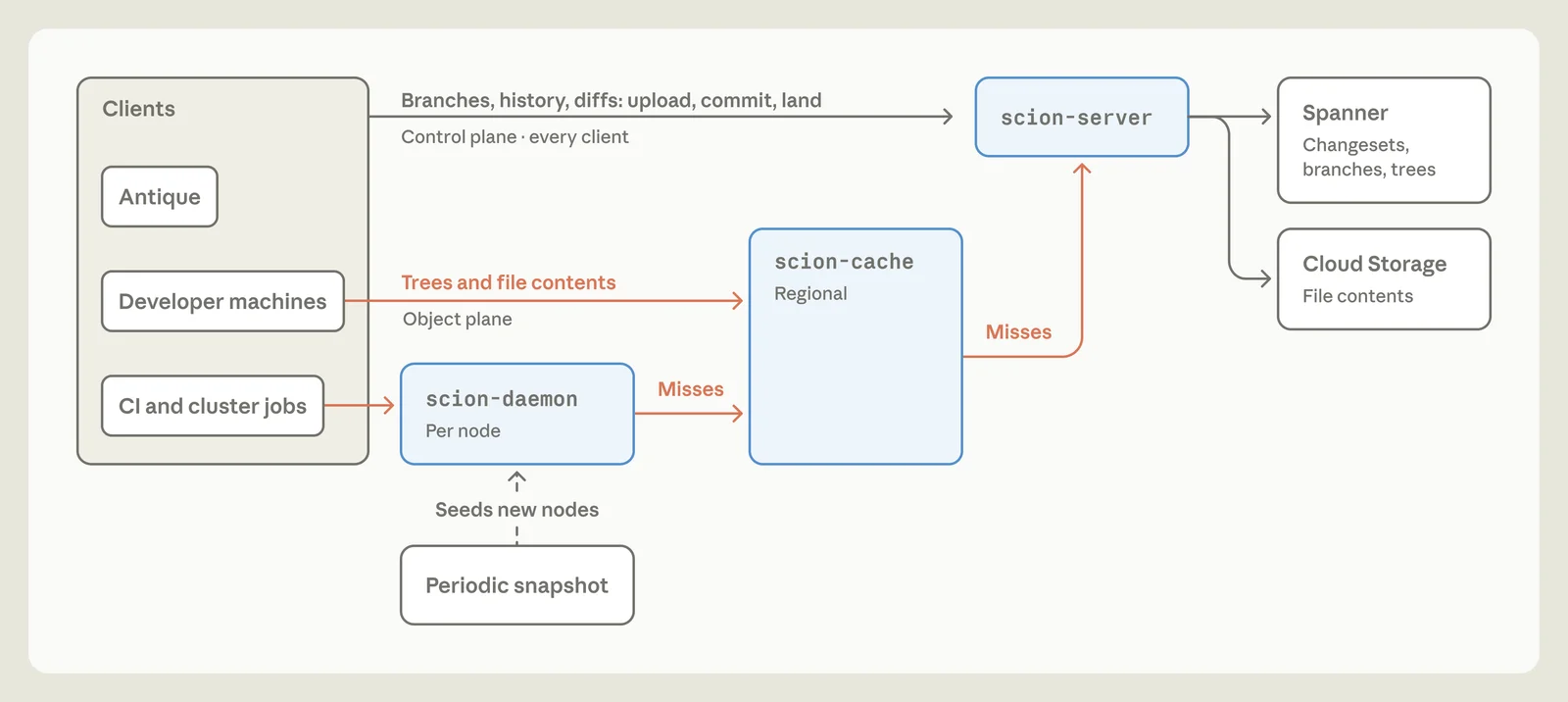
Anthropic describes an unusual infrastructure change. The company reports daily merges rising from roughly 2,500 in May to more than 30,000 in September, alongside about 25 million CI checkouts a day. Repeatedly moving history and working copies became a substantial compute and network burden. Scion moves more history queries and merge work to the server, while clients retrieve data needed for the current task. 13

The Chinese commentary and original engineering article are separate saves, discussed together here. The reported roughly 200-fold reduction concerns CPU and memory in the source-control infrastructure. It is not a 200-fold gain in developer output. 16

03 / A CHANGED WORKLOAD

Measure the workload before changing the architecture

Daily merges reported by Anthropic

May
~2,500
Sept
>30,000

Bars use 30,000 as the reference. An approximately 12× change in volume is not a productivity measure.

Anthropic’s Scion architecture: clients, node daemons, regional caches and server storage.

Original figure and metrics: Anthropic’s engineering article. The 200× claim is limited to its source-control infrastructure CPU/memory comparison. Source ↗

The useful lesson is how the team frames the problem: observe changes in workload, then revisit old assumptions. A small repository used mostly by humans has different bottlenecks from fleets of always-online agents and CI jobs. Scion responds to an exceptional workload; ordinary teams do not need to replace Git because of it.

They can, however, measure an entire delivery. How long went into writing, waiting for tests, waiting for review and rework after release? If code generation occupies a small fraction, doubling its speed cannot halve the whole cycle. As execution becomes cheaper, queues and rework become more visible.

Make the easiest path the correct one

@poteto’s original post and the saved Chinese explanation prioritize code structure, automated checks, written guidance and human review. I read this as an argument for making interfaces, types and module boundaries expose recurring errors early, instead of repeatedly telling an agent not to make them. 32

People still review. The aim is to preserve their attention for questions tools cannot settle. A type checker can detect a mismatched field; it cannot decide whether that field should be collected. An end-to-end test can reproduce a journey; it cannot decide whether the journey makes sense.

04 / WHERE TRUST COMES FROM

Turn repeated reminders into earlier feedback

Adapted from @poteto’s ordering. Width suggests priority, not a measured share of time.

  1. 01
    Code structure

    Types, boundaries, invariants

    Make recurring errors harder to introduce
  2. 02
    Automated checks

    Lint, tests, CI

    Expose deviations early
  3. 03
    Written guidance

    Rules, comments, experience

    Explain intent that tools cannot encode
  4. 04
    Human judgment

    Requirements, design, trade-offs

    Decide what to do and when to accept it

Checks cover defined properties; passing them does not establish that requirements or design are right. [32]

omp brings language services, debugging and editing tools into one working environment, giving agents program feedback instead of prose alone. The e2e migration skill recommends preserving comparisons between old and new suites, feature by feature, with a migration record. One makes mistakes visible sooner; the other reminds us that changing the verifier must not quietly discard the old standard. 26 29

Status, sessions and memory preserve different things

Pi 1.1.0’s Program Status Protocol communicates whether a program is working, blocked or finished. Tern emphasizes persistent sessions across devices. Hy Memory distinguishes chat, work and coding memory. These three product readings need not become three lengthy reports, but they occupy useful positions in a handoff. 05 09 25

A completion status tells someone to inspect the result. A session record restores the scene. Memory should explain why a decision was made. None independently constitutes acceptance. Remembering a conclusion should include when it was valid and whether it was later reversed. I would test memory with a real proposal tried and rolled back last week, rather than asking how much history it can hold.

Sunday addendum: include the requirements

Tencent’s engineering article extends AI-assisted development into requirement clarification, technical design, review and organizational knowledge. One concrete mechanism assigns knowledge an expiry date and sends it for re-evaluation; agents can report contradictions with current code. How old answers retire is more useful than a growing knowledge count. 33

This is an October 18 addition. It adds a question to the feature: without shared requirements and current ownership records, could automation simply amplify old misunderstandings faster? Process changes should reduce those misunderstandings, rather than assigning an agent to every inherited step.

↑ Back to contents
03

Research

Ideas, improvement, explanations and autonomy need different tests.

RESEARCH

When AI researches AI, what counts as progress?

Ideas, methods, explanations and autonomy each need their own evidence.

IdeaScientist: an idea should have a traceable origin

Research agents can mistake a large volume of ideas for progress. IdeaScientist separates identifying gaps, retrieving analogous solutions from other fields and developing proposals. Its evaluation limits access to earlier literature and compares proposed directions with later human papers. The saved explanation and original paper remain linked. 07 Paper

The setup asks the system to explain how it arrived at a direction. Agreement with later research offers one kind of evidence about ideation; it does not run the proposed experiment or establish a correct conclusion. My question is whether the borrowed mechanism shares a real structure with the new problem, or merely some vocabulary.

Evo²: the improver learns too

Evo² joins two changes in a loop: editing an agent’s prompts, tools and context organization—its harness—and using those edits and execution outcomes to train the model proposing and diagnosing changes. The contribution connects environmental improvement with model learning, rather than supplying another supposedly magical prompt. 20 Paper

05 / TWO DIFFERENT LOOPS

One seeks ideas; the other learns how to improve
IdeaScientist

Output: a grounded research proposal

  1. Find a gap
  2. Retrieve analogous mechanisms
  3. Develop a proposal
Next test: does an experiment support it?
Evo²

Output: an improved model and harness

  1. Propose harness edits
  2. Execute, evaluate, diagnose
  3. Train the improver from outcomes
Return to the next improvement round ↺

Editorial diagrams of the papers’ mechanisms. The two processes do not share a scoring scale or establish a general capability ranking. [07] [20]

For practitioners, the question is where an improvement came from. When the model, environment and evaluation examples all change together, it becomes difficult to know what to keep. I would compare one change at a time and reserve tasks untouched during iteration for final evaluation. The paper’s benchmark results belong to its experimental setup; our own workloads require a new test.

AI studying AI: explanations must risk being wrong

The saved Synced article describes Nick Cammarata’s interpretability work: one agent proposes an explanation of a neuron, another constructs examples predicted to activate it—or not—and the network tests those predictions. The immediate change is the scale of investigation: more hypotheses can be proposed and challenged. 27

The reported estimate that roughly 90% of neurons have a principal function has model, threshold and definition limits. It does not establish that an entire model is understood. A useful explanation predicts unseen cases and allows experiments to overturn it. A fluent story that cannot fail under any outcome is difficult to treat as a research finding.

Replication and distillation: separate levels of evidence

Anthropic’s self-replication study tests setting up inference on different hardware and chaining capabilities in simplified environments. A successful component, a successful controlled sequence and autonomous spread in the real world are distinct claims. Simplified access conditions cannot disappear in the retelling. 11

Its distillation-defense article discusses reducing unauthorized industrial-scale capability extraction. The company’s reported reduction is a defense evaluation, not proof that all data is safe. For workflows relying on upstream models, the practical implication is to keep checking interfaces and data policies rather than assuming today’s accessible output remains an unchanged resource forever. 10

06 / CLAIMS & EVIDENCE

What, exactly, has been tested?
Promising research direction

Ideas align with later research

Still needed: experiments and reproducible results
Explanations of mechanisms

An explanation predicts activation or intervention outcomes

Still needed: more mechanisms, interactions and a full audit
Autonomy in a controlled setting

A component or simplified sequence succeeds

Still needed: evidence under real conditions and end-to-end reliability

This compares evidence requirements for different claims, not model rankings. [07] [27] [11]

Together, these readings do not describe a straight line called “AI improving itself.” Ideation, method improvement, mechanism explanation and behavioral constraints have different objects of verification. Keeping them separate helps identify both real progress and the experiments and judgments people still need to make.

↑ Back to contents
04

Tools to try

Diagrams, routing, mobile testing and work you can keep editing.

Five concrete uses, illustrated with real website or author images. Thumbnails share a crop ratio; select one to view the uncropped image. Each entry offers a reason to try it and a practical question to check.

↑ Back to contents
05

People & products

Long-term trust, research evidence and how beginners learn judgment.

PEOPLE & PRODUCTS

What else should survive beyond the record?

Long-term trust includes knowing what you can take with you.

You can take the transcript. Can you take the familiar reply?

APPSO’s companion-product article raises an overlooked problem through changes in service ownership and operation: a transcript records what already happened. The next reply depends on character settings, the base model, memory selection and service policies. This section considers that product question. Individual bankruptcy and transaction claims in the article have not been independently verified here and are not presented as this issue’s news findings. 17

Work agents face a related problem. As we entrust a long-running system with plans, preferences and reasons, we depend on more than one answer: we depend on how it interprets that history. At work, we want it to continue a task; in companionship, a person may want a familiar response. Both need clearer migration expectations than “download your chat file.”

07 / WHAT CAN YOU TAKE WITH YOU?

Past records and future responses
01
History you can preserve
  • Conversations that happened
  • Explicit settings and preferences
  • Structured tasks, files and memories
02
What still depends on the live system
  • How the model composes the next reply
  • Which history is selected into context
  • Tools, policies and continued availability

Editorial distinction: export is valuable, but a file alone cannot guarantee continuity of experience. [17]

I do not think products must promise to keep the same model forever. A more practical responsibility is to expose saved memory, let users correct it, export structured data and explain significant changes. Part of long-term trust is knowing what you can take with you when you leave.

When functionality is easier to reproduce, what remains?

Kazik’s article connects cheaper AI-assisted reverse engineering with software defenses and attention. 08 My addition is to distinguish reproducing a feature, operating it reliably and earning continued use. An interface can be imitated; migration, incident handling and confidence in the next upgrade do not disappear as code gets cheaper.

DEX #367 approaches the problem from another direction: machines compress articles into summaries and people interpret the summaries—does communication become a sequence of compression and decompression? 18 This is a useful challenge to the newsletter itself. Every save should appear, but completeness does not require equal-length reports. Editing should put explanatory material together, identify disagreements and leave routes back to the originals. It should increase understanding, not just reading load.

One research desk, two return stories

The long Opus 5.5 quant-research guide has something more valuable than its “24/7” headline: it asks the reader to fix the research universe, evidence timestamps and arithmetic rules first. A company with listings in several markets must not casually become several companies in the sample. Information learned today cannot enter a historical decision. Only after resolving those issues should AI computation produce comparable results. 03

Two trading posts, meanwhile, claim that tiny starting balances rapidly became thousands of dollars. In one, 48 to 7,492 implies a balance difference of 7,444, which does not directly reconcile with the roughly 3,350 profit also mentioned. The other lacks a complete inspectable ledger too. These are promotional, author-reported accounts. They remain in the directory but are not used to chart returns or establish a strategy’s effectiveness. 21 23

The contrast makes me want to define permissible conclusions before execution. A careful research desk can return “not calculated” or “not reproduced.” A system required to produce an impressive answer every time may be harder to trust.

Sunday addendum: where do beginners learn to review?

A newly saved APPSO article discusses Anthropic’s internal employment report and a difficult tension: companies increasingly value judgment, yet beginners used to learn judgment through small tasks and mistakes. This is a reading and interpretation of that report, not a causal conclusion about the whole labor market from one company’s hiring changes. 34

If all entry-level work goes to agents and newcomers are expected to review them immediately, the training path breaks. I would try pairing delivery with learning: have a newcomer write acceptance criteria and predict failure points, examine the agent’s solution, reproduce one failure personally and explain why the change should be accepted. AI handles repetitive execution while the person still practices forming a judgment. Organizations need to measure both completed work and whether it leaves the next colleague understanding the system better.

Leave a starting point for tomorrow

One of Lachel’s everyday suggestions connects unexpectedly with the issue: leave a progress note so the next session has an entry point. 01 People forget why they stopped yesterday too. Recording where the work stands, what is blocked and what comes next helps colleagues and agents—and tomorrow’s version of ourselves.

That is the cover scene: progress, evidence and a next step on Airing’s desk. The point of delegating work is to be able to leave with confidence and return without starting over.

↑ Back to contents
Every saved reading34 / 34

The period follows save dates, not original publication dates. Editorial work draws on original research, product websites and saved full-text articles; community cases were not independently reproduced. AIGC #192 may be incomplete, and two newsletters have no public original URL. Readings 33 and 34 are Sunday additions.

  1. 01

    Ten small changes for a better everyday life

    李睿秋Lachel(L先生说) · 2026-10-11

  2. 02

    Dots and Jev: a persistent work setup

    @noisyb0y1 · 2026-10-11

  3. 03

    Building a 24/7 quant research desk

    @Av1dlive · 2026-10-11

  4. 04

    Getting started with a Grok Bot team

    @AnatoliKopadze · 2026-10-11

  5. 05

    Pi 1.1.0 and Program Status Protocol

    @xiaomovps · 2026-10-11

  6. 06

    The Grok Bot team harness and handoffs

    @0xCodez · 2026-10-11

  7. 07

    IdeaScientist: grounded cross-domain ideas

    @Xudong07452910 · 2026-10-11

  8. 08

    AI reverse engineering and software defenses

    数字生命卡兹克(微信公众号) · 2026-10-12

  9. 09

    Tern: sessions that outlive a window

    Stencil Labs(stencil.so · X @stencil_labs) · 2026-10-12

  10. 10

    Anthropic’s distillation defenses

    Anthropic(Policy · 2026-10-12) · 2026-10-13

  11. 11

    Anthropic’s self-replication study

    Anthropic Frontier Red Team · William Zhou, Daniel Freeman(2026-10-12) · 2026-10-13

  12. 12

    What should a personal agent look like?

    Founder Park(微信公众号) · 2026-10-14

  13. 13

    Scion: redesigning source control

    Anthropic Engineering · Nick G. 与源码控制团队(2026-10-13) · 2026-10-14

  14. 14

    ExcaliClaw: collaborative diagrams

    ExcaliClaw 官网 · excaliclaw.com(Product Hunt) · 2026-10-14

  15. 15

    AIGC Weekly #192

    歸藏 / AIGC Weekly · 2026-10-14

    Saved reading ↗Saved newsletter · no public linkIn this issue ↗
  16. 16

    Scion: a Chinese commentary

    尹John / AGI Hunt · 2026-10-14

  17. 17

    AI companions and relationship continuity

    发现明日产品的 APPSO(微信公众号) · 2026-10-14

  18. 18

    DEX #367: compression and decompression

    DEX 周刊 <dingyi@quailymail.com> · 2026-10-14

    Saved reading ↗Saved newsletter · no public linkIn this issue ↗
  19. 19

    Connecting Grok Bot teams to Feishu

    Kin(@KinGao476942) · 2026-10-15

  20. 20

    Evo²: weight and harness co-evolution

    Xudong Han(@Xudong07452910) · 2026-10-15

  21. 21

    A promotional 48-to-7,492 trading claim

    春日部彼得(@crbpite8) · 2026-10-15

  22. 22

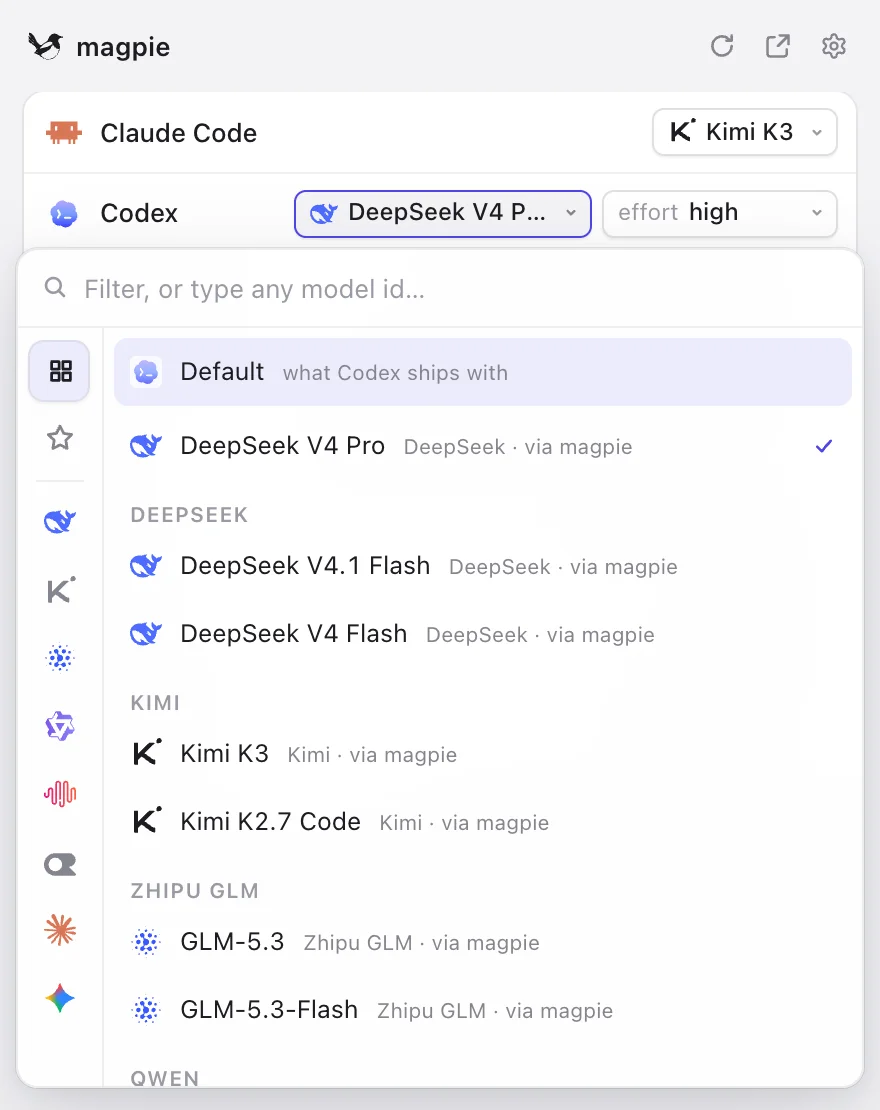
    magpie: a local model gateway

    Asada-Yuki(@AsadaYuki_Art) · 2026-10-15

  23. 23

    A promotional copy-trading claim

    春日部彼得(@crbpite8) · 2026-10-15

  24. 24

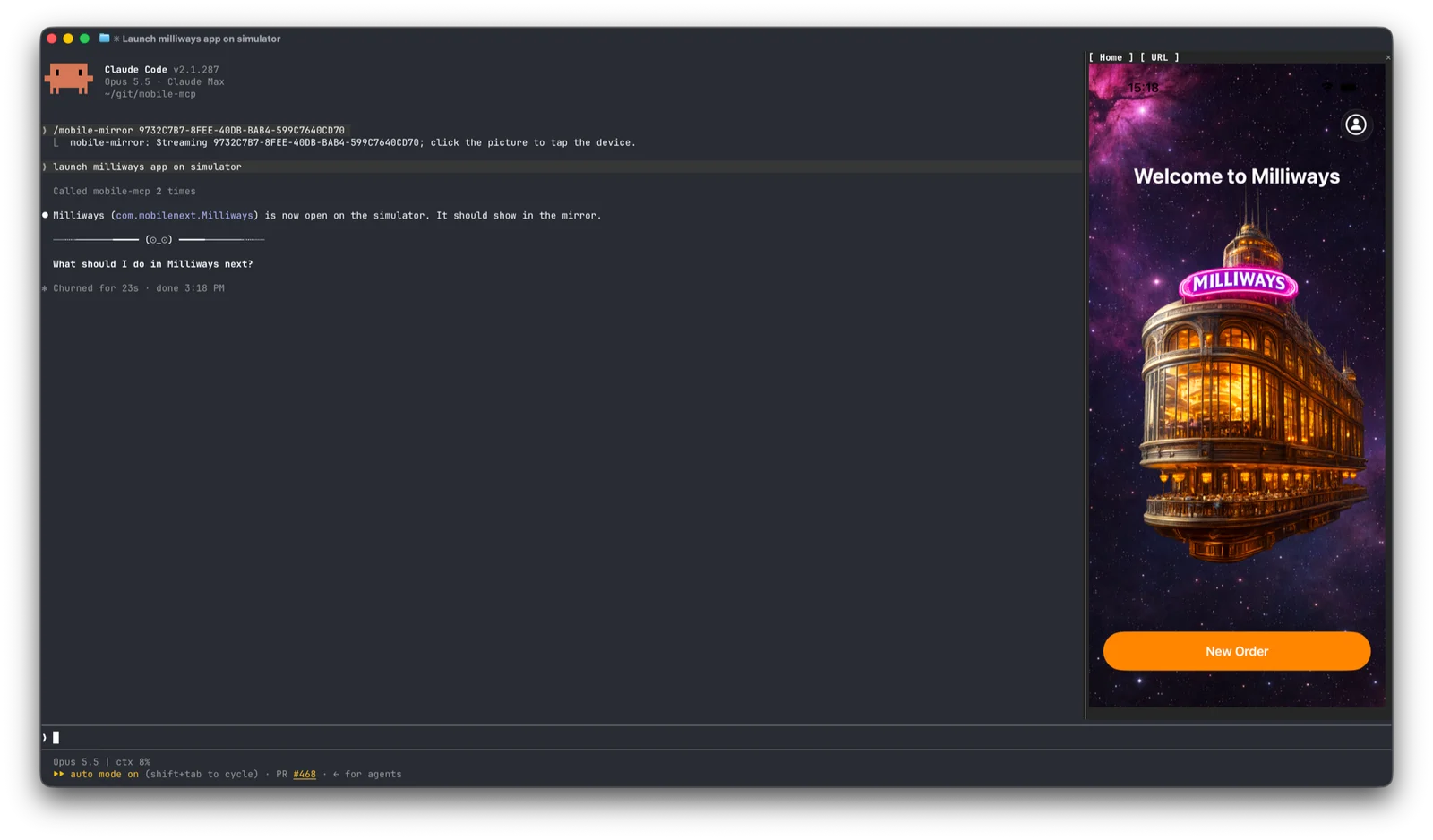
    mobile-mcp: real-device automation

    ThirdBro(@dngzsn37461) · 2026-10-15

  25. 25

    Hy Memory: an agent-memory SDK

    腾讯混元 · Tencent-Hunyuan/Hy-Memory · 2026-10-16

  26. 26

    omp: an agent with IDE tools

    omp 官网 · omp.sh · 2026-10-16

  27. 27

    AI-assisted neural interpretability

    机器之心(微信公众号) · 2026-10-16

  28. 28

    Dots and Blender: overnight creation

    KeJun(@yrmkejun) · 2026-10-16

  29. 29

    Migrating end-to-end tests with e2e

    kaito(@cu30rry_) · 2026-10-17

  30. 30

    Pi on Cloudflare Durable Objects

    jiangkoumo(@jiangkoumo_) · 2026-10-17

  31. 31

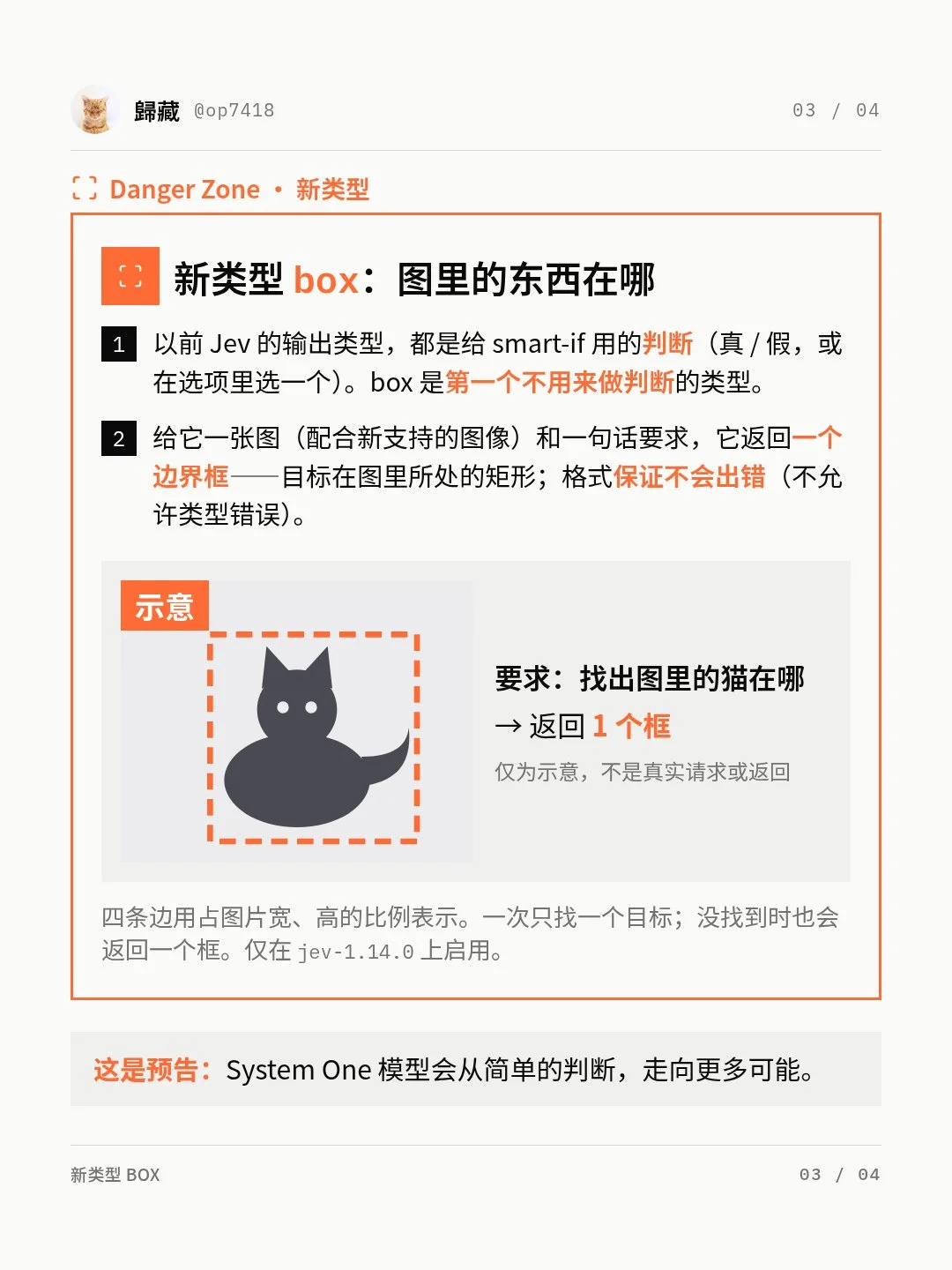
    JEV 1.14.0: images and boxes

    歸藏(guizang.ai) (@op7418) · 2026-10-17

  32. 32

    Four layers of trust in agent work

    meng shao (@shao__meng) · 2026-10-17

  33. 33

    Rebuilding the whole development workflow

    腾讯技术工程(微信公众号)· danteyang · 2026-10-18 · Sunday addendum

  34. 34

    Junior hiring, AI work and learning judgment

    APPSO · 2026-10-18 · Sunday addendum

KEEP THE DISCOVERIES COMING

A week of AI reading, sent to you.

Every Monday. The cover, theme guide and every reading, in English or Chinese. One email per issue.

Weekly RSS ↗

READ WITH A FRIEND

Share this issue

AI Trends Weekly 004 · Always on. Ready to hand over?

Save the cover and send it to a friend who reads with you.

Follow what matters

订阅 Airing

选择接收方式,再决定你真正想看的内容。

新一期编好后发送;周刊邮件中可切换语言或退订。