COVER STORY
AI released 700-plus manuscripts. Why are mathematicians divided?
On October 6, OpenAI released mathematical research generated by an internal model. Some saw an acceleration of discovery; others called for a boycott. What lies behind these different responses?
Our lead reading is Kazike’s essay on AI’s transformation of mathematics, alongside APPSO’s reporting and mathematicians’ original statements. Start with the event, then follow what changes in research.
What happened on October 6?
On October 6, OpenAI published openai/math, a GitHub collection of mathematical manuscripts and proof artifacts generated by an unreleased internal model. Existing mathematics evaluations had become less informative, so the company expanded evaluation to open research problems. The significant change is what the model was being asked to produce: arguments about unresolved questions, beyond answers to established exercises.
A manuscript is a research draft. It states a claim and its assumptions, then presents an argument. Public release allows scrutiny and follow-up work; it is not the same as completed peer review. The collection includes materials at different verification stages, and several documents can belong to one result: companion arguments, consequences or alternative proofs.
BACKGROUND / THE RELEASE AND RESPONSE
First, put the release in context
Concerns predate the release
AGMAI, an independent advisory group, publishes advice on autonomy and assimilation.
OpenAI releases manuscripts
An internal model attempts open problems; materials are released for scrutiny.
Corrections and public opposition
Three withdrawals are recorded; the Association for Human Mathematics (AHM) calls for a boycott.
The 719 manuscripts cover 372 problem families; one family can contain multiple manuscripts.
Counts use the repository version checked for this issue. Manuscripts, distinct problems and peer-reviewed papers are different units; absence of formalization does not mean a result is false.
Prominent examples concern the Riemann zeta function, connected to the distribution of prime numbers; faster matrix multiplication; and a four-dimensional Kakeya problem. Readers need not master the details to see the significance. AI is attempting questions researchers have pursued, producing arguments that can be examined beyond how convincingly they read.
Corrections followed release. The initial 722 manuscripts became 719 after three withdrawals; the version used here groups them into 372 result families. Optimists see the scale of machine exploration. Cautious readers see a large body of material still requiring scrutiny. The dispute begins with both observations being possible at once.
What do the three mathematical results actually claim?Optional background · scope, diagrams and manuscripts
For more background on these three problems, start with the diagrams below. They explain the reported claims and their scope; follow the originals for the full proofs.
Quasi-Riemann: a fixed zero-free boundary
The main manuscript reports a zero-free region to the right of 7/8, with an 11/12 companion proof. Neither settles the full Riemann hypothesis. The case illustrates traceable research arguments, whose validity still depends on scrutiny of their exact statements and proofs.
01 / A BOUNDARY IN THE COMPLEX PLANE
7/8 moves the boundary left, but does not reach 1/2
s = σ + it. Horizontal: real part. Vertical: imaginary part, with no height bound. No zeros are sampled here.
- 1/2
- The Riemann targetAll nontrivial zeros of ζ(s) lie on this line.
- 7/8
- The primary proof’s fixed boundClaims no zeros for Re(s) > 7/8; the pole at s=1 for principal functions is handled separately.
- 11/12
- The alternative proof’s boundSame result family, a bound further to the right. Keep the constants of the two proofs separate.
Matrix multiplication: an exponent bound, not training speed
The manuscript reports an exponent bound of 9/4 over complex numbers with an arbitrary positive epsilon. The illustration compares asymptotic leading growth, not measured acceleration of a GPU or model.
02 / COMPUTATION GROWTH
Change the multiplication algorithm, not just one cell
c₁₁ = a₁₁b₁₁ + a₁₂b₂₁
Four output cells need eight scalar multiplications by the naive method. Strassen reorganizes block multiplication into seven and recurses.
Double the matrix side: how much does leading work grow?
Editorial asymptotic illustration comparing 2^ω, omitting constants and epsilon. Not measured speed or a claim about small matrices.
Original manuscript / The scope of theorem 1.1
Enlarge ↗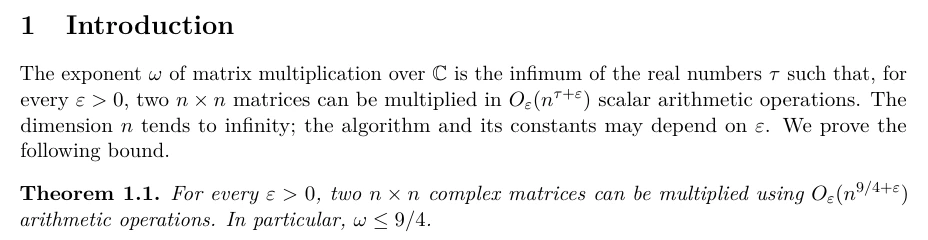
Four-dimensional Kakeya: dimension and volume differ
The manuscript claims full Hausdorff dimension for a set containing a unit segment in every direction in four dimensions. The two-dimensional sketch is an introduction, not the proof or a claim of positive volume.
03 / DIRECTIONS AND DIMENSION
Every direction imposes a condition on the whole set
Two-dimensional illustration. Segments may translate independently, without sharing a center. This does not depict a four-dimensional proof.
Dimension asks how spatial complexity grows at finer scales
R⁴ → dimH = 4The four-dimensional claim: a unit segment in every direction forces Hausdorff dimension four.
Intuitive dimension examples. Full Hausdorff dimension does not imply positive volume; keep the quantities distinct.
Why this matters: AI is contributing paths into research
Earlier discussions of AI mathematics often centered on solving exercises with known answers or translating a human proof into a machine-checkable language. An open problem has no ready answer key. A system must find a viable argument, navigate obstacles and present something others can examine. Valid contributions to that process constitute research progress regardless of their machine origin.
Kazike’s most useful argument connects progress to the speed of feedback. Where results can be checked quickly, AI can attempt a route, encounter failure and try again. More directions become accessible within a given period. Mathematics and code attract attention partly because some outputs can be connected to automatic checks.
CAPABILITY / A RESEARCH PATH
Follow a research path to see what AI contributes
An unsolved problem
Prior work, definitions and constraints
LemmaB
RefuteC
New route
Turn attempts into candidate arguments
- Check the derivation
- Establish its relation to prior work
- Make it understandable and reusable
Counterexamples, checks and new understanding reshape the next attempt.
Process schematic; A/B/C are not measured branch counts. AI can help explore, verify and explain. The diagram does not prescribe a permanent human–AI division of work.
A missing step still matters: finding an argument, formalizing it and confirming that it addresses the intended problem are different jobs. The collection is the output of an evaluation and preparation process. The model contributed arguments; problem selection, earlier literature, checking tools and selection for release also shaped the result.
The prospect is larger than finishing one problem faster. Researchers could explore routes they previously lacked time to pursue, compare alternatives and extract useful methods. That is a substantive expansion of working capacity. A selected collection of successes, however, does not establish a general success rate for an arbitrary new research question.
What are the objections actually about?
The saved APPSO article brings another side into view: errors in the manuscripts, the release process and researchers’ concerns about their future roles. Its tension with Kazike’s essay is useful. One emphasizes consequences for the mathematical community; the other emphasizes the possibilities opened by AI capability. Neither is fully represented by its headline.
Two organizations matter. The Association for Human Mathematics, AHM, called on October 7 for mathematicians to discontinue work with OpenAI. It questioned whether this release model advances understanding. The Advisory Group on Mathematics and Artificial Intelligence, AGMAI, is an independent group of scholars. It too objects to frontier research testing on inaccessible proprietary models, but continues discussions with labs and recommends better release practices and support for understanding.
DEBATE / THE DIFFERENT CLAIMS
One release, three different concerns
OpenAI
Manuscript publisher
Central claimEvaluate an internal model on unsolved mathematical problems.
ActionRelease manuscripts and some research traces for outside scrutiny.
AHM
Association for Human Mathematics
Central claimProducing proofs in bulk is not the same as developing shared mathematical understanding.
ActionCalls for an end to collaboration with OpenAI and for research centered on human understanding.
AGMAI
Advisory Group on Mathematics and AI
Central claimAccess, research autonomy and the community’s capacity to assimilate results belong in the evaluation.
ActionRecommends stopping advanced-math testing on proprietary models and funding community assimilation through independent institutions.
Paraphrased from primary statements. AGMAI’s advice is not an endorsement; Tao’s hosting of AHM’s guest article does not make it a statement for all mathematicians.
“Mathematicians boycott AI” collapses these positions. Tao’s blog hosted an AHM-authored guest statement; that does not establish that he led its authorship. AGMAI’s advisory work is not an endorsement of the collection. The useful questions are who is speaking, what practice they object to and what they propose.
The withdrawals reported by APPSO are a real quality concern and should affect trust in unchecked material. They do not show that every result is false. Conversely, a valid proof does not settle every question about publication and collaboration. The common ground is that technical change is already affecting research work; the terms for evaluating and sharing that change remain contested.
Why doesn’t Lean settle the dispute?
Think of Lean as a language for stating mathematical definitions, claims and proofs precisely. Its proof kernel checks whether an argument follows the rules under its stated assumptions. This gives readers a way to check corresponding artifacts beyond trusting an author’s assertion.
But a successful check concerns the statement actually encoded. Consider a simple example: someone intends to prove that every integer has a positive square, but adds “the integer is nonzero” in the formal statement. The revised claim is true; the original fails at zero. The checker has not malfunctioned. The task changed. Research-level differences can be much subtler, so the original question, manuscript and formal statement must still be matched.
WORKED EXAMPLE / CHECK THE STATEMENT
An extra condition can make the proof work—and change the question
∀ n ∈ ℤ, n² > 0
Every integer has a positive square.
∀ n ∈ ℤ, n ≠ 0 ⇒ n² > 0
Every nonzero integer has a positive square.
An introductory example, not an error found in these manuscripts, Lean code or an executed checker result. Formal verification checks the encoded claim; fidelity to the intended question still needs scrutiny.
Correctness also leaves other questions open. An argument may rediscover a known result, or provide little explanation of its method. Kazike is right to draw attention to fast feedback as an accelerator. Treating the entire cost of research assessment as the cost of one check, however, leaves out literature review, explanation and application. Formalization coverage also needs an explicit scope.
These jobs need not remain exclusively human. A Lean kernel postmortem records AI-assisted bug finding, and models can also assist literature search, statement comparison and counterexample discovery. The promising technical direction improves generation and scrutiny together, producing reasons for trust that another researcher can reuse.
If proofs become cheaper, who supports understanding?
Imagine a doctoral student planning several months of work who discovers that AI has released a possible proof of the same problem. That may be good news for the field, while requiring a major change to the student’s project. They must check the result, then choose whether to change direction, extend it or learn its method. Receiving an answer and developing research ability happen on different timescales.
This illustrates why “more results must be better” does not end the argument. Explanations, discussion and use carry results into other people’s work. When output grows faster than the ability to assimilate it, attention shifts toward selection and understanding. Which results deserve attention first? Who explains them? How is that labor supported and recognized?
ACCESS / WHAT REACHES THE COMMUNITY?
Access to results and access to research tools are different opportunities
Readers can inspect outputs without necessarily being able to initiate comparable research.
Tools, resources and recognition support question-setting, understanding and training new researchers.
An editorial comparison of research conditions, not a quantitative measure of access or cost.
AGMAI proposes that labs support the assimilation of substantial output that is not yet well understood, with established nonprofit academic institutions directing funding decisions. Workshops, sustained working groups and exposition can help turn a released answer into usable knowledge.
Access raises a further question. A public proof lets others examine a result; accessible research tools let them pursue their own questions. Both matter in different ways. The worrying scenario concentrates agenda-setting and discovery inside a few labs, leaving others primarily to receive outputs. The preferable one expands the number of researchers able to explore directions of their own choosing.
Will this follow the earlier resistance to AI in art?
The comparison is understandable. A profession built around difficult skills encounters automation at scale; excitement coexists with concern about work and value. Artists and mathematicians can share that experience. But “there was resistance” is not enough to establish the analogy. We must ask what was contested and whether those conditions subsequently changed.
A closer mathematical precedent is Appel and Haken’s 1976 computer-assisted proof of the four-color theorem: four colors suffice for a planar map when regions sharing a boundary must differ. Extensive computation raised questions about both reliability and understanding. Thurston still used the example in 1994 to discuss mathematical understanding. A formal proof completed in 2005 strengthened the basis for checking. New mechanisms of trust developed without eliminating the desire for insight.
HISTORY / WHAT ACTUALLY CHANGED?
Historical changes involve verification and the terms of cooperation
Mathematics: how do we trust a machine-assisted proof?
- Computer-assisted proof
The four-color proof relies on extensive computation, raising questions of reliability and understanding.
- Understanding matters
Thurston discusses how proof communicates understanding among mathematicians.
- Formal verification
Gonthier’s formal proof supplies a further machine-checkable foundation.
Later work adds ways to verify while keeping understanding in view.
What differs todayToday AI also generates research arguments. Output scale, proprietary tools and access to research add further issues.
Creative work: whose work trained the model?
- Opposition to unlicensed training
Creators’ statement focuses on permission to use their work and threats to livelihoods.
- Some partnerships negotiate terms
WMG and Suno announce licensed collaboration with a creator opt-in framework.
Adoption can coexist with negotiation over permission, pay and choice.
What differs todayOne partnership does not establish universal benefit. Artistic value also lacks a theorem’s true-or-false test.
Sources: Thurston, Gonthier, the 2024 training statement and WMG’s announcement. Events are ordered, not drawn to time scale or as an inevitable sequence.
In the arts, the 2024 AI training statement objected to unlicensed use of creative works and its effect on livelihoods. Its claim was not simply that machines could never produce good art. Warner Music Group and Suno’s 2025 partnership announcement emphasized licensing and creator choice. It illustrates that adoption and negotiation can coexist. It does not establish that all artists benefited or that earlier objections became groundless.
Mathematical truth has checking methods unlike judgments of artistic value. Today’s AI also generates research arguments, reaching beyond earlier computer-assisted computation. The useful lesson is therefore a concrete institutional adaptation, rather than inevitable surrender: checkable proofs, accessible tools, explicit credit and sustainable training can turn concerns into better terms of use.
How can collaboration go beyond generating and reviewing proofs?
Imagining AI writing proofs and people reviewing them overlooks the cycle of research. Proofs suggest new questions; failed routes can leave useful methods. Models may help ask questions and explain arguments as well as solve them. A permanent boundary in which humans supply meaning and machines execute is therefore an uncertain foundation.
A more constructive relationship begins with an actual task. A researcher identifies something they want to understand; a model suggests possible routes. Examples, counterexamples and literature help eliminate unsuitable paths. Once an argument develops, its key ideas and checking materials are prepared for others to use. AI can participate throughout, while contributions remain open to questioning.
RELATIONSHIP / KEEP THE LOOP OPEN
Results should feed the next round of research
- 01→
Frame a worthwhile question
People and AI propose candidates and explain why they matter.
- 02↓
Develop arguments and counterexamples
Explore lemmas, examples and alternative proof routes.
- 03←
Check and explain the contribution
Check derivations, intended statements, prior work and scope.
- 04↑
Make further research possible
Share explanations, tools and failed approaches to enable new questions.
Understanding, tools and developed expertise become the starting point for new questions.
A proposed practice in which people and AI participate across stages. Access, research resources and academic incentives matter alongside model capability.
Students particularly need opportunities to develop judgment. I would allow model assistance with background and alternatives, while asking students to explain assumptions, identify a failed example and reason again when conditions change. That distinguishes obtaining a proof from learning to conduct research. Sanderson’s argument for recognizing explanatory work and Lozano-Robledo’s discussion of students both direct attention toward developing that capacity.
Academic incentives must support it. If recognition depends only on new-result counts, clear exposition, proof organization and teaching methods become under-rewarded support work. Better tools should increase the value of those activities too. Otherwise a larger volume of results can coexist with fewer opportunities for researchers to develop independently.
Beyond solving problems: building a shared practice of research
Kazike’s essay is the lead recommendation because it makes a consequential shift visible: AI is extending from assistance with reading and exercises into the production of research. That warrants both excitement and specific verification. APPSO and the original statements supply another part of the story: discussion, access and transferable methods help new results expand a field’s capabilities.
I would neither dismiss the dispute as wounded professional pride nor conclude that AI should stay out of research. Continued collaboration is more promising, with explanation, scrutiny and support built into release practices. Machines can contribute ideas; researchers need the means to examine, alter and build on them.
The next evidence to watch is independent scrutiny, follow-on research and access for students and researchers beyond the labs. Those developments will reveal whether the release mainly adds documents or expands usable knowledge. The remaining features pursue a related question: how capabilities become sustained work whose steps can be inspected and understood.